
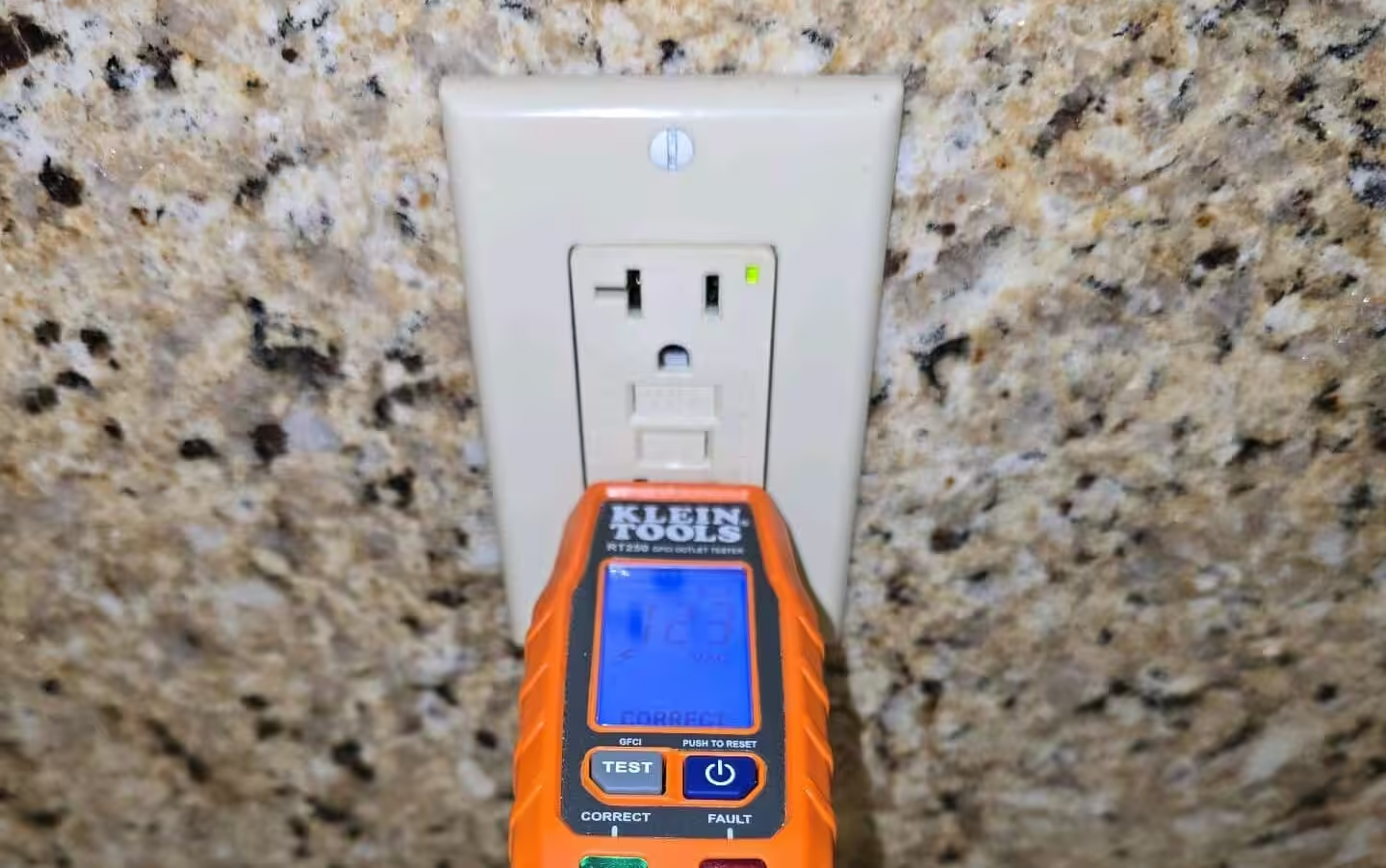
A GFCI outlet, or Ground-Fault Circuit Interrupter, is an electrical safety device designed to reduce the risk of serious electrical shock.
GFCI protection is especially important in locations where electricity may be used near water or where conditions increase the potential for a ground fault.
Bathrooms and kitchens are probably the locations most homeowners associate with GFCI outlets, but GFCI protection is also commonly found in garages, exterior areas, laundry areas, crawl spaces, and other locations throughout a home.
One important distinction is that GFCI protection does not always mean the receptacle itself will have TEST and RESET buttons. A standard-looking receptacle may be protected by another GFCI device located upstream or by a GFCI circuit breaker in the electrical panel.
Understanding how this protection works can help homeowners and buyers make sense of one of the most common electrical items evaluated during a home inspection.
What Does GFCI Mean?
GFCI stands for Ground-Fault Circuit Interrupter.
A ground fault occurs when electrical current unintentionally travels outside its intended path.
For example, damaged electrical equipment, moisture, or another electrical fault could allow current to travel through an unintended path.
If a person becomes part of that path, serious electrical shock can occur.
A GFCI is designed to detect certain differences between the electrical current traveling through a circuit and the current returning from it.
When that difference indicates current may be escaping its intended path, the GFCI quickly disconnects power.
How Does a GFCI Outlet Work?
A GFCI continuously monitors the electrical current flowing through the circuit.
Under normal conditions, the amount of current traveling out through the circuit should closely correspond with the amount returning.
If the GFCI detects a small imbalance indicating that some current may be traveling along an unintended path, it trips and interrupts the circuit.
This can happen extremely quickly.
The purpose of this rapid response is to reduce the risk of serious electrical shock or electrocution.
This is different from the primary function of a standard circuit breaker.
Is a GFCI the Same as a Circuit Breaker?
Not exactly.
A traditional circuit breaker is primarily designed to protect the electrical wiring and equipment against conditions such as overloads and short circuits.
A GFCI is primarily designed to protect people from electrical shock associated with ground faults.
The two types of protection address different electrical hazards.
GFCI protection can also be incorporated directly into a circuit breaker.
A GFCI breaker can therefore provide traditional overcurrent protection while also providing ground-fault protection for the circuit.
What Does a GFCI Outlet Look Like?
A typical GFCI receptacle looks similar to a standard electrical receptacle but usually includes two buttons on its face:
TEST
and
RESET
The TEST button is used to verify that the GFCI can trip and interrupt power.
The RESET button restores power after the device has tripped, assuming the condition that caused the trip is no longer present.
Some newer devices may also include indicator lights showing the operating status of the GFCI.
Where Is GFCI Protection Commonly Required?
GFCI requirements have expanded over time.
Modern residential electrical standards commonly require GFCI protection in numerous areas where ground-fault risks may be increased.
Depending on the installation and applicable requirements, these can include locations such as:
- Bathrooms
- Kitchens
- Garages
- Exterior receptacles
- Crawl spaces
- Basements
- Laundry areas
- Receptacles near sinks
- Areas near bathtubs and showers
- Certain appliance and equipment locations
- Other damp or wet locations
The exact requirements depend on factors including the location, circuit, equipment, installation, and electrical requirements applicable to the property.
A home inspection is not a municipal code inspection, and the presence or absence of GFCI protection should be evaluated in the context of the home’s electrical system and installation.
Are GFCI Outlets Required in Bathrooms?
GFCI protection is a standard safety feature for bathroom receptacles.
Bathrooms combine electrical equipment with sinks, faucets, showers, tubs, and other sources of water, increasing the importance of ground-fault protection.
During a home inspection, bathroom receptacles are typically evaluated for GFCI protection and proper operation when accessible.
A missing or nonfunctional GFCI in a bathroom may be documented as an electrical safety concern.
Are GFCI Outlets Required in Kitchens?
GFCI protection is commonly required for kitchen receptacles under modern electrical standards.
Requirements have expanded significantly over time, so the answer is no longer limited to receptacles immediately beside the kitchen sink.
However, the applicable requirements can depend on when the electrical installation was performed and the specific configuration.
During a home inspection, accessible kitchen receptacles are commonly tested to determine whether appropriate ground-fault protection is present and functioning.
Are GFCI Outlets Required in Garages?
Garages are another common location for GFCI protection.
Garage receptacles may supply power to:
- Power tools
- Battery chargers
- Refrigerators
- Freezers
- Garage equipment
- Exterior equipment
- Other portable electrical devices
Because garages can also be exposed to moisture, concrete floors, exterior conditions, and portable equipment, ground-fault protection provides an important additional layer of electrical safety.
Are Outdoor Outlets Required to Be GFCI Protected?
GFCI protection is commonly required for outdoor receptacles.
Exterior electrical equipment can be exposed to:
- Rain
- Humidity
- Irrigation
- Wet landscaping
- Pools and spas
- Pressure washing
- Extension cords
- Power tools
- Other outdoor conditions
These conditions can increase the potential for electrical current to travel along an unintended path.
During a home inspection, accessible exterior receptacles are commonly evaluated for GFCI protection and other electrical concerns.
Are GFCI Outlets Required in Laundry Areas?
Modern electrical requirements include GFCI protection in laundry areas.
Laundry rooms commonly contain electrical equipment near water supplies, washing machines, utility sinks, and other plumbing components.
Older homes may not have the same level of protection found in newer construction because GFCI requirements have expanded over time.
When evaluating an older home, the age and configuration of the electrical system should therefore be considered.
Does Every Outlet Near a Sink Need GFCI Protection?
Modern electrical requirements generally require GFCI protection for receptacles within specified distances of sinks, along with broader requirements for certain rooms and locations.
Historically, homeowners often heard a simplified rule such as “within six feet of a sink.”
While distance from a sink remains relevant in certain applications, modern GFCI requirements are broader than that single rule.
The room, receptacle location, equipment, circuit, and applicable electrical requirements can all matter.
Does Every GFCI-Protected Outlet Need TEST and RESET Buttons?
No.
This is a very common misconception.
One GFCI device can sometimes protect additional receptacles farther downstream on the same circuit.
Those downstream receptacles may look completely normal and may not have TEST or RESET buttons.
They can still have GFCI protection.
For example:
GFCI Receptacle → Standard Receptacle → Standard Receptacle
If properly wired, the downstream receptacles can receive GFCI protection from the first device.
A GFCI circuit breaker located in the electrical panel can also provide protection to multiple outlets on a circuit.
This is why the absence of TEST and RESET buttons does not automatically mean a receptacle lacks GFCI protection.
Can One GFCI Protect Multiple Outlets?
Yes.
A properly configured GFCI receptacle can provide protection to other receptacles downstream.
GFCI receptacles generally have connections identified for incoming power and downstream protected loads.
When properly installed, additional outlets connected through the protected side of the device can receive GFCI protection.
This arrangement is common in residential electrical systems.
It can also explain why pressing the TEST button on one GFCI suddenly causes several other receptacles to lose power.
Why Did My GFCI Outlet Trip?
A GFCI trips when it detects an electrical imbalance consistent with current escaping its intended path.
Potential causes can include:
- Moisture
- Damaged electrical equipment
- Defective appliances
- Damaged wiring
- Exterior electrical exposure
- Faulty cords
- Electrical leakage
- A problem elsewhere on the protected circuit
- A defective GFCI device
Occasional tripping does not automatically identify the source of the problem.
If a GFCI repeatedly trips, the underlying cause should be determined rather than continually resetting the device.
Why Does My GFCI Keep Tripping?
A GFCI that repeatedly trips may be detecting an actual electrical fault.
For example, an exterior receptacle may be exposed to moisture, an appliance may have electrical leakage, or wiring somewhere on the protected circuit may be damaged.
Repeated tripping can also result from a defective GFCI device.
Because one GFCI can protect multiple downstream outlets, the problem may not be located at the receptacle containing the TEST and RESET buttons.
If the GFCI continues to trip after connected equipment has been removed, evaluation by a qualified electrical professional may be appropriate.
Why Won’t My GFCI Outlet Reset?
There are several possible reasons a GFCI may not reset.
These can include:
- No incoming power
- A tripped circuit breaker
- Another GFCI tripped upstream
- An active ground fault
- Incorrect wiring
- A defective GFCI
- Damage to the circuit
- A problem with downstream equipment
A GFCI that refuses to reset should not simply be assumed to be a bad outlet.
The condition may originate elsewhere in the circuit.
Can a GFCI Outlet Go Bad?
Yes.
GFCI devices can fail.
Like other electrical components, they can deteriorate with age, use, electrical events, environmental exposure, or internal component failure.
This is one reason GFCI devices include a TEST function.
If a GFCI does not respond properly when tested, the device or circuit may require further evaluation.
How Do You Test a GFCI Outlet?
Most GFCI receptacles have a built-in TEST button.
A basic functional test generally involves pressing the TEST button and verifying that the device interrupts power.
The RESET button is then used to restore power.
Home inspectors may also use testing equipment to evaluate accessible receptacles and determine whether ground-fault protection responds as expected.
Testing should never involve disassembling electrical equipment or exposing energized components.
If a GFCI does not trip or reset properly, further evaluation may be warranted.
How Often Should GFCI Outlets Be Tested?
GFCI devices should be tested periodically according to the manufacturer’s instructions.
Many devices include testing instructions directly on the receptacle or associated product information.
Regular testing helps determine whether the protective mechanism is still functioning.
A receptacle that continues to provide electricity but fails its GFCI test may not be providing the protection a homeowner assumes is present.
Do Older Homes Need GFCI Protection?
Older homes often have less GFCI protection than newer homes because electrical safety requirements have expanded over time.
For example, a home built decades ago may have originally been constructed without GFCI protection in locations where it would be expected in modern construction.
That does not automatically mean the entire electrical system was improperly installed when the home was built.
However, GFCI protection provides an important safety benefit, particularly in locations where electrical equipment may be used near water or damp conditions.
Homeowners with older electrical systems may want to discuss appropriate safety upgrades with a qualified electrician.
Can You Install a GFCI in an Older Two-Wire Electrical System?
In certain applications, GFCI protection can be used as part of an appropriate upgrade to older ungrounded electrical systems.
However, GFCI protection does not create an equipment grounding conductor.
This distinction is important.
A GFCI may provide shock protection even where a traditional equipment grounding conductor is absent, but the electrical system remains ungrounded unless an appropriate grounding path is actually present.
Older electrical systems should be evaluated based on their wiring configuration, receptacles, grounding, labeling, and other applicable installation requirements.
Does a GFCI Outlet Need a Ground Wire to Work?
A GFCI’s primary protective function is based on detecting an imbalance in electrical current rather than relying solely on an equipment grounding conductor.
This means a GFCI can provide ground-fault protection in certain ungrounded installations.
However, installing a GFCI does not create a ground where one does not exist.
A receptacle can therefore be GFCI protected while still lacking an equipment grounding conductor.
These are two different electrical characteristics.
What’s the Difference Between GFCI and AFCI Protection?
GFCI and AFCI devices protect against different electrical hazards.
A GFCI is primarily intended to reduce the risk of electrical shock from ground faults.
An AFCI, or Arc-Fault Circuit Interrupter, is designed to detect certain dangerous electrical arcing conditions that can contribute to electrical fires.
Some electrical devices provide both AFCI and GFCI protection.
Although the acronyms sound similar, the devices serve different purposes.
Does a GFCI Protect Against Electrical Overloads?
GFCI protection should not be confused with standard overcurrent protection.
A traditional circuit breaker or fuse protects the electrical circuit against excessive current associated with overloads and short circuits.
A GFCI detects certain current imbalances associated with ground faults.
A GFCI circuit breaker can incorporate both types of protection into one device.
Understanding the difference is important because simply having GFCI protection does not eliminate the need for properly sized breakers, conductors, and other electrical protection.
Can Missing GFCI Protection Affect a Four Point Inspection?
It can be documented as an electrical deficiency during a Four Point Inspection.
Florida Four Point Inspections include an evaluation of readily accessible components of the home’s electrical system.
Depending on the property and electrical installation, missing or nonfunctional GFCI protection may be documented on the inspection report.
However, the home inspector does not determine whether an insurance carrier will ultimately accept the property.
The inspector documents the condition. The insurance carrier makes the underwriting decision.
Carrier requirements can vary, and repairs or additional documentation may be requested depending on the insurer.
Does a Failed GFCI Mean the Home Fails Inspection?
No.
A standard home inspection is not a pass-or-fail inspection.
If an accessible GFCI does not operate properly during testing, the inspector may document the condition and recommend appropriate correction.
The finding should be considered in the context of the overall electrical system.
Similarly, a Four Point Inspection documents conditions for insurance underwriting purposes. The insurance company, not the home inspector, determines its underwriting requirements.
What Do Home Inspectors Look for With GFCI Protection?
During a home inspection, accessible electrical receptacles and GFCI devices may be evaluated for conditions such as:
- Presence of GFCI protection
- Proper response during testing
- Devices that fail to reset
- Receptacles that lose power when a GFCI trips
- Damaged receptacles
- Loose devices
- Missing covers
- Heat damage
- Improper wiring indications
- Ungrounded receptacles
- Other visible electrical deficiencies
Testing has limitations.
Furniture, appliances, stored belongings, inaccessible receptacles, occupied equipment, or other conditions may prevent every outlet from being evaluated.
The inspection also does not involve dismantling concealed electrical wiring throughout the home.
Should You Replace a GFCI That Doesn’t Work?
A GFCI that does not operate properly should be evaluated and appropriately corrected.
The solution may involve replacing the GFCI device, but the device itself is not always the source of the problem.
For example, failure to reset may result from:
- Loss of incoming power
- An upstream electrical problem
- Incorrect wiring
- A downstream ground fault
- Circuit damage
- Another electrical deficiency
The underlying cause should be determined rather than assuming replacement of the receptacle alone will solve the problem.
Can a Homeowner Replace a GFCI Outlet?
Replacing a receptacle involves working with the home’s electrical wiring and requires the circuit to be properly de-energized and the device correctly connected.
GFCI devices also have specific connection requirements.
Incorrect installation can result in a receptacle that appears functional but does not provide the intended protection.
Homeowners who are not qualified or comfortable performing electrical work should have a qualified electrical professional perform the repair.
Electrical work should never be attempted on an energized circuit.
When Should an Electrician Evaluate a GFCI Problem?
Professional electrical evaluation may be appropriate when:
- A GFCI repeatedly trips
- A GFCI will not reset
- The device fails to trip during testing
- Receptacles unexpectedly lose power
- Heat damage is visible
- Burning odors are present
- Moisture has entered electrical equipment
- Wiring appears damaged
- Grounding is uncertain
- Electrical modifications appear improper
- Multiple receptacles have electrical problems
Repeatedly resetting a protective device without determining why it is tripping can leave an underlying electrical problem unresolved.
GFCI Protection and Home Inspections
GFCI protection is an important part of a home’s residential electrical system.
These devices are intended to reduce the risk of serious electrical shock by quickly interrupting power when certain ground-fault conditions are detected.
During a home inspection, GFCI protection is commonly evaluated in areas such as bathrooms, kitchens, garages, exterior locations, laundry areas, and other applicable locations when readily accessible.
An important part of that evaluation is understanding that the receptacle itself does not necessarily need TEST and RESET buttons to be protected.
Protection may originate from another GFCI receptacle or from a GFCI breaker in the electrical panel.
The Bottom Line
A GFCI outlet is an electrical safety device designed to reduce the risk of serious electrical shock by detecting certain differences between current leaving and returning through a circuit.
When a ground fault is detected, the device quickly interrupts power.
GFCI protection is commonly associated with bathrooms and kitchens, but modern requirements extend to numerous other areas of the home, including garages, outdoor locations, laundry areas, crawl spaces, basements, areas near sinks, and certain equipment locations.
Older homes may have less GFCI protection because electrical requirements have expanded over time. That does not automatically mean the home was improperly constructed, but additional GFCI protection may provide an important safety upgrade.
Homeowners should also remember that a standard-looking outlet may still be GFCI protected by another device upstream or by a breaker in the electrical panel.
If a GFCI repeatedly trips, will not reset, fails testing, or shows signs of damage, the underlying electrical condition should be evaluated rather than simply continuing to reset the device.
For a broader explanation of electrical panels, branch wiring, circuit breakers, grounding, protection devices, and common electrical findings, see Electrical Systems: What Homeowners and Buyers Should Know.
For additional information about residential electrical systems and common electrical conditions identified during home inspections, visit the Tier-1 Pro Electrical Knowledge Center.