
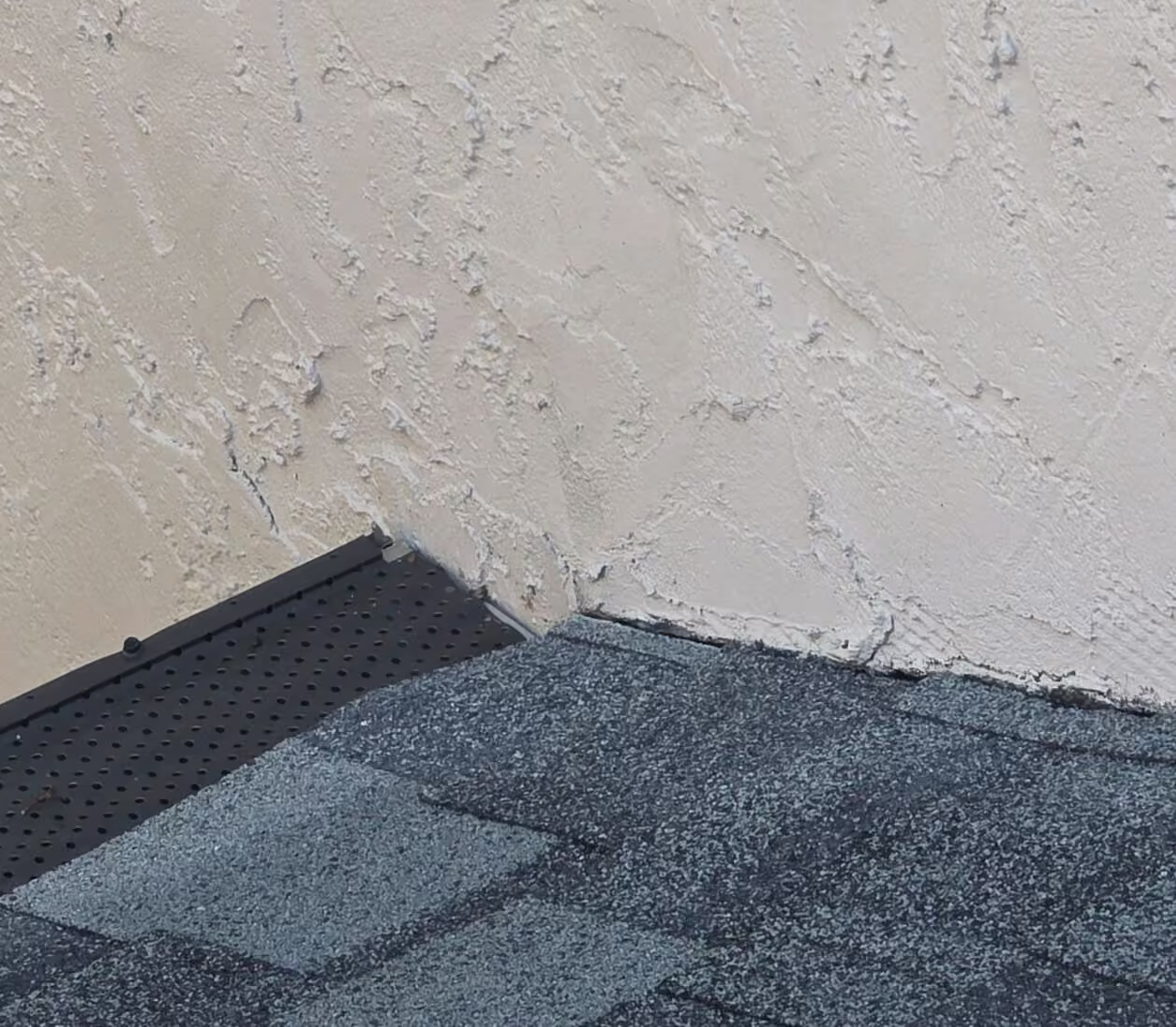
A missing kickout flashing detail may look minor, but it can put a large volume of roof runoff exactly where a wall is least equipped to handle it. At the bottom of a roof-to-wall intersection, a properly installed diverter directs water away from the wall and toward the intended drainage path.
What kickout flashing does
Where a sloped roof meets a taller exterior wall, rain travels along the sidewall flashing. At the bottom, a kickout diverter turns that runoff away from the siding or stucco. Without it, water can repeatedly wash down the wall, enter vulnerable transitions, or reach concealed sheathing. The detail must work with the roof covering, wall weather barrier and other flashing, rather than acting as an isolated piece of metal.
Warning signs during a home inspection
Inspectors may identify an absent, undersized, bent or poorly integrated diverter. Staining, discoloration, deteriorated trim, damaged stucco or moisture-related finishes below the roof-to-wall intersection may strengthen the concern, but visible stains alone do not establish the exact leakage path.
The concern is especially relevant during Florida downpours, when a substantial amount of runoff can concentrate at one location. Even an apparently dry interior does not eliminate the possibility of concealed damage.
Why a bead of caulk is not a substitute
Applying sealant to the outside of the joint does not automatically restore proper water management behind the wall cladding. Repair may require a roofer to coordinate with a stucco or siding contractor so the roof flashing and wall drainage plane overlap correctly. The Building America Solution Center’s installation guidance illustrates why integration matters.
What an inspection can and cannot establish
A standard visual inspection can document visible flashing deficiencies and related surface conditions. It generally cannot determine the extent of hidden sheathing damage without further evaluation. A qualified roofing contractor should assess suspect transitions and determine the proper repair scope.
Where the missing detail matters
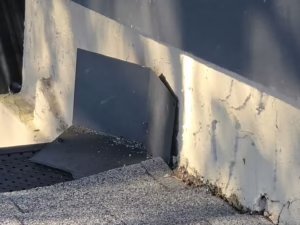
A kickout diverter is most important where a lower roof slope ends against a taller wall. Rainwater runs down the intersection and can concentrate at the bottom. Gutters alone do not correct a missing diverter: the roof and wall flashing still need to send runoff into the intended drainage path. A roofer should check the whole transition rather than treating the visible metal piece as an isolated repair.
What to look for below the roofline
Staining, deteriorating trim, damaged stucco, peeling paint and repeated moisture-related repairs can be clues to recurring wetting. These observations cannot establish the extent of concealed deterioration. Water may travel inside assemblies before it becomes visible indoors, so a dry interior surface does not prove the transition is performing correctly. Buyers can ask about any known history of water entry or previous flashing repairs.
Questions to ask before approving repairs
Ask the roofing contractor to explain where runoff currently goes, whether the existing sidewall flashing is continuous, and how the proposed diverter will integrate with the wall’s water-resistive barrier. A durable correction may require carefully opening a small portion of the roof or exterior finish to establish the correct overlaps. A surface application of sealant alone is not necessarily a suitable repair. The contractor should also address any observed deterioration and advise whether further evaluation of concealed materials is warranted.
How to prioritize this finding
A missing or improperly installed diverter deserves timely evaluation because rainfall is repeatedly directed toward a vulnerable transition. That does not automatically mean the roof needs replacing or that there is concealed rot. For a home buyer, obtaining a roofer’s assessment before closing can clarify the likely scope, including whether other trades will be needed to repair surrounding finishes. For current owners, document where water flows during safe ground-level observation of rainfall, but do not climb onto a wet or steep roof to investigate.
Field Insight
Missing or improperly installed kickout flashing is surprisingly common here in Central Florida. Wherever a roof slope intersects a sidewall, kickout flashing is needed to direct runoff away from the exterior cladding. When it’s missing or improperly installed, we frequently observe evidence of water intrusion in these areas.
Most homes we inspect have stucco exteriors, which makes proper flashing especially important. Stucco over wood-framed walls is particularly vulnerable to moisture-related damage when water gets behind the cladding. Concrete masonry unit (CMU) walls aren’t immune to these issues either, although the resulting damage is often less severe than what we see with wood-frame construction.
For related details, see our roof flashing guide, the roof systems overview and our Roof Knowledge Center. If you are buying a home in Central Florida, a comprehensive home inspection can help identify visible roof-to-wall drainage concerns before closing.