
Older homes in Central Florida have a lot going for them. They tend to sit on larger lots in established neighborhoods with mature tree canopy, they were often built with construction methods and materials that don’t exist in production homebuilding anymore, and they’re frequently priced well below comparable new construction in the same area. The tradeoff is that a home built in the 1960s, 70s, or early 80s has had four to six decades for its systems to age, for materials that were standard at the time to fall out of favor for good reasons, and for the specific vulnerabilities of its era to develop into either non-issues or expensive problems depending on how the home was maintained. The single most common question buyers ask when they’re under contract on an older Central Florida home is which inspections they actually need — and the answer is more specific than “get a home inspection and hope for the best.”
A standard pre-purchase home inspection is the foundation, and every older home purchase should start there. But the value of inspecting an older home comes from understanding that certain systems and materials carry era-specific risks that warrant focused attention, and that several of the most consequential issues in older Central Florida homes are ones a general inspection will flag but that benefit from the deeper evaluation a specialized ancillary service provides. The goal isn’t to order every inspection available — it’s to match the inspections you order to the specific risk profile of the home’s age and construction, so that what you learn before closing reflects what the home will actually cost to own, insure, and maintain.
The Electrical Systems of Older Homes Deserve Specific Attention
Electrical systems are where the age of a home most directly intersects with both safety and insurability, and older Central Florida homes carry several era-specific electrical conditions that a buyer needs to understand. Homes built or wired in the 1950s through the 1970s may contain wiring and panel configurations that were entirely standard at the time but are now recognized as elevated-risk, and the practical consequence isn’t just a safety question — it’s an insurance question that can affect whether you can get a policy at all.
Certain electrical panel brands installed widely during this period, including Federal Pacific Electric Stab-Lok, Zinsco, and Pushmatic, have documented histories that lead most Florida insurance carriers to treat them as high-risk, and many carriers will decline to write a policy or require replacement before binding coverage. This is one of the most common ways an older-home purchase runs into an insurance obstacle, and it’s precisely the kind of thing you want documented during the inspection period rather than discovered when your insurance agent reviews the four point inspection results. A home inspection identifies the panel brand and flags the concern; understanding the full picture of why these panels are treated the way they are, and what your options are, is covered in depth in our article on electrical panel recalls and double-taps. The important thing for an older-home buyer to know is that a problematic panel is a solvable problem when it’s identified before closing, when it becomes a negotiating point rather than a post-closing expense.
Beyond panel brands, older homes may contain aluminum branch wiring — common in construction from the mid-1960s through the early 1970s — which carries a higher fire risk than copper when connections aren’t properly maintained and terminated, and in the oldest homes, knob-and-tube wiring, an early wiring method that predates modern grounding and that insurers and inspectors flag when it’s still in service. Neither of these is a reason to walk away from a home you otherwise want, but both are conditions that a buyer needs to understand going in, because they affect insurability, they may require remediation, and they change the cost picture of ownership. Our article on knob-and-tube wiring covers what it is and why inspectors call it out in more detail for buyers who encounter it.
Plumbing in Older Homes: What’s Underground and Behind the Walls
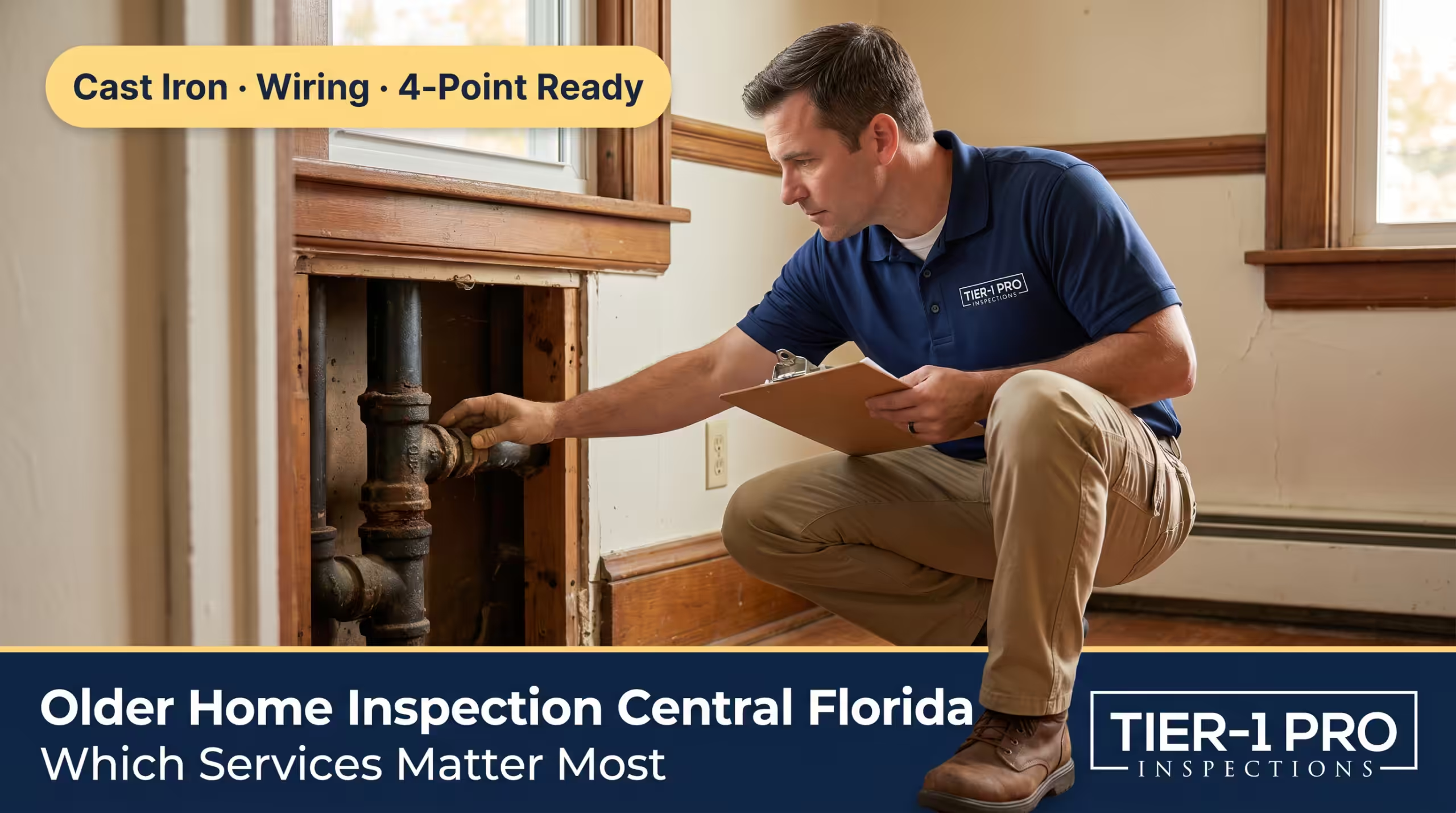
The plumbing systems of older Central Florida homes carry their own era-specific concerns, and the most significant of them is largely invisible during a standard walkthrough. Homes built before roughly 1975 frequently have cast iron drain and sewer lines, a material that was standard for decades and that has a finite lifespan compressed by Florida’s soil chemistry, high water table, and the corrosive gases that develop inside drain lines. Cast iron pipe that has reached the end of its service life pits, thins, cracks, and eventually collapses, producing drain backups and sewer line failures that are entirely the homeowner’s financial responsibility and that can run from several thousand dollars for a partial repair to well into five figures for a full lateral replacement.
Because cast iron deterioration happens underground and behind walls, it’s the clearest example of why an older-home buyer benefits from a specialized inspection beyond the general evaluation. A sewer scope inspection runs a camera through the drain line and shows the actual interior condition of the pipe — deterioration, root intrusion, offset joints, and belly sections that no surface inspection can reveal. For any Central Florida home built before 1985, a sewer scope is close to a default recommendation, and our article on sewer scope inspection covers exactly what it finds and why it matters for older homes specifically. The supply plumbing warrants attention too — older homes may have galvanized steel supply lines that corrode from the inside over decades, reducing water pressure and eventually failing, and homes from the late 1970s through the mid-1990s may contain polybutylene, a supply material with a well-documented failure history that many insurers won’t write coverage over. A home inspection identifies the supply material and its visible condition, and a four point inspection documents it for insurance purposes.
The Four Point Inspection Becomes Central for Older Homes
For homes over a certain age — and most Florida carriers apply this at 10 years or older, which every home in the older category comfortably exceeds — a four point inspection is typically required before an insurance carrier will write or renew a policy. This makes the four point inspection not just advisable but functionally mandatory for older-home buyers who need homeowners insurance, which is to say nearly all of them. The four point inspection evaluates the four systems most likely to produce insurance claims — roof, electrical, plumbing, and HVAC — and for an older home, it’s the document that ties together several of the era-specific concerns already discussed into a single assessment that your insurer will use to make its coverage determination.
The reason the four point inspection deserves emphasis for older homes specifically is that it’s often where the era-specific issues become financially concrete. An aging roof approaching the end of its insurable life, a problematic electrical panel, deteriorating plumbing materials — these are exactly the conditions the four point inspection documents, and they’re exactly the conditions that determine whether an older home is straightforward to insure, insurable only with conditions attached, or difficult to insure at standard rates. For an older-home buyer, understanding the four point inspection outcome before the inspection contingency expires is what separates a smooth path to closing from an unwelcome surprise at the insurance stage. Our article on four point inspections in Florida covers what the inspection evaluates and how the process works in full.
The Roof and the HVAC: Age-Driven Realities
The roof on an older home is frequently the single largest capital consideration in the purchase, because a roof that’s approaching or past the end of its serviceable life in Florida’s climate is both a maintenance obligation and an insurance obstacle. Florida carriers scrutinize roof age heavily, and an older asphalt shingle roof — even one that shows reasonably well from the street — may be at the boundary of insurability. For older-home buyers, understanding the roof’s age, material, and remaining useful life is essential to pricing the transaction correctly, and our article on how long a roof lasts in Florida covers the lifespan expectations by material and the insurance implications in detail. A roof replacement is a significant expense, but knowing it’s on the horizon before closing gives a buyer the ability to negotiate it as a credit or price adjustment rather than absorbing it as an unbudgeted post-closing cost.
HVAC systems in older homes are worth evaluating with realistic expectations about equipment lifespan. Air conditioning systems in Florida work harder and longer than in almost any other climate, and an older home may have an HVAC system that’s near the end of its service life even if it was replaced at some point after original construction. A home inspection evaluates the system’s condition and approximate age, and for a buyer, an aging but functional system represents a foreseeable future expense that should factor into the ownership cost picture. The ductwork in older homes also deserves attention, as decades-old duct systems may have developed leaks, insulation failures, or configurations that compromise efficiency in ways that raise energy costs and reduce comfort.
How to Prioritize: Assembling the Right Inspection Package
For a buyer under contract on an older Central Florida home, the practical framework is to start with the comprehensive pre-purchase home inspection as the non-negotiable foundation, add the four point inspection that the insurance requirement makes necessary, and then layer in the specialized ancillary inspections that the home’s specific age and characteristics warrant. The priorities generally break down as follows:
- For nearly any home built before 1985, seriously consider a sewer scope inspection given the cast iron risk.
- For homes with any indication of electrical concerns — a visible older panel, aluminum wiring, or a home old enough to potentially contain knob-and-tube — the electrical findings from the home inspection may warrant follow-up evaluation by a licensed electrician before closing.
- If the home has a pool, a dedicated pool inspection applies as it would for any home.
- If the home is on a private well, water testing and a well inspection are warranted, particularly in the rural and semi-rural areas of Lake, Volusia, and Osceola counties where older homes on wells are common.
The mistake to avoid in both directions is either treating an older home like a new one and ordering only a basic inspection, or over-ordering out of anxiety without matching the inspections to the actual risk profile. An older home in Central Florida has a known and specific set of vulnerabilities driven by its era of construction, and the right inspection package is the one that targets those vulnerabilities directly — giving you a complete and accurate picture of what the home will cost to own before you’re committed to owning it. An older home that’s been well-maintained and whose era-specific concerns have been addressed over the years can be an excellent purchase. The inspections are how you find out which kind of older home you’re actually buying.
People Also Ask
What inspections do I need when buying an older home in Florida?
Start with a comprehensive pre-purchase home inspection and a four point inspection, which most insurers require for homes over 10 years old. Then add specialized inspections based on the home’s characteristics — a sewer scope inspection is strongly recommended for homes built before 1985 due to cast iron plumbing, a pool inspection if the home has a pool, and water testing plus a well inspection if the home is on a private well. The goal is to match the inspections to the specific risks of the home’s age and construction.
Why are older homes harder to insure in Florida?
Older homes frequently have conditions that Florida insurers treat as elevated-risk: aging roofs approaching the end of their insurable life, older electrical panel brands with documented safety histories, deteriorating plumbing materials like cast iron and polybutylene, and outdated wiring methods. A four point inspection documents these conditions, and the carrier uses that documentation to decide whether to write a policy, at what price, and with what conditions attached. Many of these issues are resolvable, which is why identifying them before closing matters.
What electrical problems are common in older Central Florida homes?
Common era-specific electrical concerns include problematic panel brands like Federal Pacific Electric, Zinsco, and Pushmatic that insurers treat as high-risk; aluminum branch wiring common in mid-1960s to early-1970s construction; and in the oldest homes, knob-and-tube wiring that predates modern grounding standards. A home inspection identifies these conditions, and follow-up evaluation by a licensed electrician is often advisable when they’re present. None of these are automatic reasons to avoid a home, but all affect safety, insurability, and cost.
Do I need a sewer scope on an older home?
For any Central Florida home built before 1985, a sewer scope inspection is close to a default recommendation. Homes of that era frequently have cast iron drain and sewer lines that deteriorate over decades in Florida’s soil and water conditions, and the resulting failures are expensive and entirely the homeowner’s responsibility. A sewer scope runs a camera through the line to reveal its actual interior condition, identifying deterioration, root intrusion, and structural problems that are invisible from the surface. The modest cost of the inspection is minor relative to the cost of a sewer line repair or replacement.
Is it a bad idea to buy an older home in Florida?
Not at all. Older homes offer advantages — larger lots, established neighborhoods, mature landscaping, and often lower prices than comparable new construction. The key is going in with a clear understanding of the home’s condition, which is what a properly assembled inspection package provides. An older home whose era-specific concerns have been maintained and addressed can be an excellent purchase. The inspections are how you distinguish a well-maintained older home from one carrying deferred problems, so you can make an informed decision and negotiate appropriately.
How old does a home have to be to need a four point inspection?
Most Florida insurance carriers require a four point inspection for homes 10 years old or older, though some apply it to homes as young as five years. Every home in the “older home” category comfortably exceeds this threshold, which makes the four point inspection functionally mandatory for older-home buyers who need homeowners insurance. The inspection evaluates the roof, electrical, plumbing, and HVAC systems and produces the document your insurer uses to make coverage decisions.