
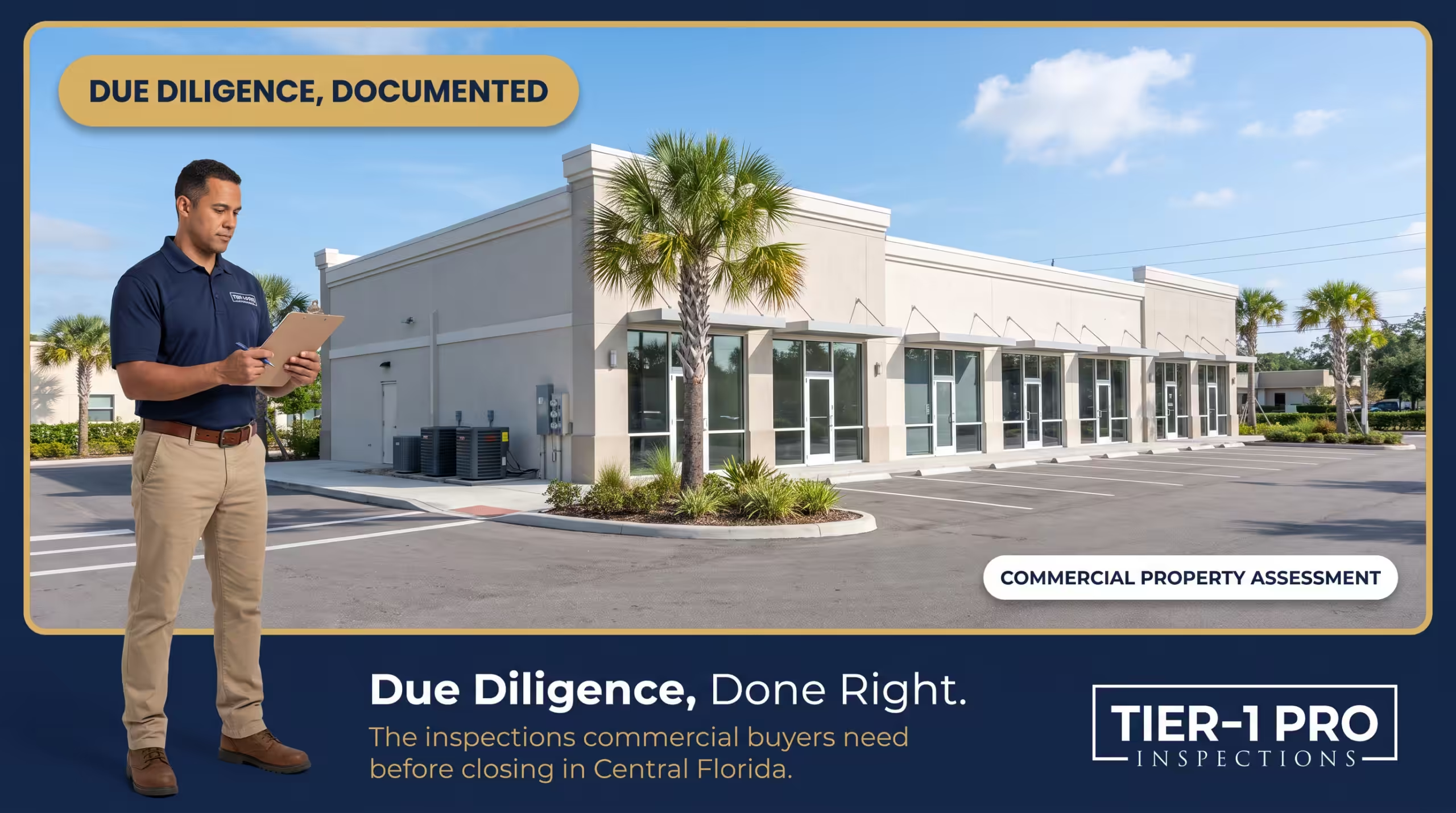
Commercial real estate due diligence typically requires four inspections: a Property Condition Assessment (PCA) of the building and site, a Phase I Environmental Site Assessment, specialty evaluations such as roof, HVAC and life-safety systems, and a documentation review of permits, past reports and maintenance records. Together they tell you what you are buying and what it will cost to keep.
That is the short answer. The longer answer is that commercial due diligence is a scheduling problem as much as a technical one. You have a defined contingency window, several vendors to coordinate, and a lender who wants a report in hand before funding.
This guide walks through the sequence we use with investors, owner-occupants and buyers of retail, office, light industrial and multifamily property across Orange, Seminole, Lake and Volusia counties.
What Commercial Due Diligence Actually Covers
Residential inspection and commercial inspection are different disciplines. A home inspection follows a fixed standard and produces a defect list for a single family. Commercial due diligence produces a decision document for a business, and its scope is negotiated up front between you, your lender and your inspector.
The work generally divides into four tracks:
- Physical condition — structure, roof, envelope, mechanical, electrical, plumbing, site and accessibility.
- Environmental — soil, groundwater and historical land use, handled by a licensed environmental professional.
- Documentary — permits, certificates of occupancy, prior reports, warranties, service contracts and maintenance logs.
- Financial and legal — leases, estoppels, title, survey and zoning, handled by your attorney and broker.
An inspection firm owns the first and third tracks. Knowing where each track begins and ends keeps your contingency period from stalling while everyone waits on someone else.
The Property Condition Assessment Explained
A Property Condition Assessment is the core physical inspection in commercial real estate due diligence. It is guided by ASTM E2018, the standard practice for baseline property condition assessments, and it produces a written report your lender and your investment committee can both use.
Tier-1 delivers a PCA-style report to the InterNACHI-CCPIA Commercial Standards of Practice. The assessment covers the building systems, the site, and the observable condition of everything a tenant or owner will rely on day to day.
What a PCA Report Includes
A useful PCA report does more than list observations. It organizes them so you can act.
- A walk-through survey of structure, roof, exterior envelope, interiors, mechanical, electrical, plumbing, vertical transportation where present, and life-safety systems.
- Site review covering paving, drainage, grading, retaining features and exterior lighting.
- Documentation review of available permits, prior engineering or inspection reports, and maintenance records.
- Cost-to-remedy estimates for identified deficiencies, so you can price the work rather than guess at it.
- An opinion on remaining useful life for major systems, which supports your capital planning.
Immediate Repairs Versus Replacement Reserves
PCA findings usually sort into two buckets. Immediate repairs are items that need attention now — a failed rooftop unit, a trip hazard in the parking lot, a panel with no working clearance.
Replacement reserves are the predictable expenses ahead of you. A 22-year-old TPO roof and a 2011 packaged HVAC unit are both still functioning, but both belong in your five-year and ten-year budgets. Separating the two is what turns an inspection into a financial model input.
Phase I Environmental Site Assessment: Where It Fits
A Phase 1 Environmental Site Assessment is a records-and-interview investigation into whether the property has a history of contamination. It reviews historical aerial photos, city directories, regulatory databases, prior ownership and adjacent land use, then documents any recognized environmental conditions.
In Central Florida the common triggers are former gas stations, dry cleaners, auto repair shops, agricultural land converted to commercial use, and older industrial parcels along the rail corridors. Lenders on commercial loans usually require a Phase I before funding, and it is the step that establishes the innocent landowner defense under federal law.
Tier-1 does not perform environmental testing. That work belongs to a licensed environmental professional, and we will tell you plainly when a property profile suggests you should order one early. Phase I typically takes two to three weeks, so it should be the first thing you commission, not the last.
Specialty Inspections Worth Adding
A baseline PCA is a survey, not a destructive investigation. When a system is old, large or expensive, a specialist adds resolution that protects your number.
Roof
Roofing is the single largest deferred-maintenance line item on most Central Florida commercial buildings. Flat and low-slope roofs take a beating from afternoon storms and standing water, and a full replacement on a 20,000-square-foot roof is a serious capital event. Drone imagery and infrared thermal imaging help identify saturated insulation and ponding areas without cutting the membrane.
HVAC
Packaged rooftop units run hard here nearly year-round. A mechanical contractor can pull service history, check refrigerant type, and confirm whether units still on R-22 are worth maintaining or should be scheduled for replacement.
Life Safety and Accessibility
Fire alarm, sprinkler and emergency lighting have their own inspection and testing requirements under Florida code. Accessibility review matters most when you plan a change of use or a tenant build-out, because that is when the permit office looks closely.
Structural and Geotechnical
Sinkhole activity and karst geology are real considerations in parts of Lake, Orange and Seminole counties. Visible settlement, stair-step cracking in masonry, or a documented history of repairs justifies a structural engineer.
A Commercial Due Diligence Checklist and Timeline
Most Central Florida commercial contracts allow 30 to 60 days for inspection. Here is a sequence that fits inside that window.
- Days 1 to 3. Order the Phase I ESA and schedule the PCA. Request the seller’s document package: permits, certificates of occupancy, prior reports, roof and HVAC warranties, service contracts, utility bills and maintenance logs.
- Days 4 to 10. Complete the PCA site work. Coordinate tenant access notices in advance so occupied suites can be viewed.
- Days 10 to 20. Review the PCA report. Order specialty inspections for any system flagged as significant.
- Days 15 to 25. Verify zoning, permitted use and any open or expired permits with the local building department.
- Days 20 to 35. Collect specialty reports and contractor bids. Build your immediate-repair and reserve schedules.
- Days 30 to 45. Negotiate credits, price adjustments or seller repairs before your commercial inspection contingency expires.
Tenant access is the most common cause of delay. Leases usually require advance written notice, and a single uncooperative tenant can push your site work back a week. Ask for the notice requirements on day one.
Triple Net Leases and Investor-Owned Property
A triple net lease shifts taxes, insurance and maintenance to the tenant, which makes it easy to assume the building is not your problem. It is still your asset.
A triple net lease inspection answers two questions that show up on the day the lease ends:
- Has the tenant actually maintained the systems the lease assigns to them?
- What condition will the building be in at expiration, relative to the return standard written into the lease?
Compare the maintenance records against what the inspection found. If the lease requires quarterly HVAC service and the units show clear neglect, you have a documented gap to raise before closing. For net-lease investors buying at a cap rate, deferred maintenance is a direct reduction in the value you are paying for.
Documentation Review: The Step Most Buyers Rush
Paperwork often reveals more than a walk-through. A room that looks finished may have been built without a permit, and an open permit from 2014 becomes your problem at closing.
Ask for and review:
- Certificate of occupancy and any change-of-use approvals.
- Permit history from the county or municipality, including open and expired permits.
- Prior inspection, engineering or environmental reports.
- Roof and equipment warranties, plus proof they are transferable.
- Service contracts and maintenance logs for HVAC, fire systems and elevators.
- Utility histories, which often reveal envelope or mechanical inefficiency the eye cannot see.
Tier-1 includes documentation review in the PCA scope. Comparing the record against field conditions is how you find the addition that never got a final inspection.
Reading the Report Like an Investor
Not every finding changes a deal. Sort findings by dollar impact and by timing, then map them to your hold period.
A $4,000 electrical correction is a punch-list item. A $180,000 roof due in three years is a capital plan. A structural condition requiring engineering review is a reason to extend the contingency and get a second opinion.
Objective reporting matters here. Your inspector should not be advising you to buy or walk away. The job is to give you accurate condition data and defensible cost-to-remedy estimates, so you and your advisors can make the call.
Working With Tier-1 on Commercial Assignments
Tier-1 Pro Inspections is led by Sean Richards, a Certified Master Inspector and 20-year U.S. Army veteran. Commercial work rewards the same habits that shaped that career: methodical scoping, careful documentation and a report that says exactly what was observed.
Our commercial property inspection services cover Orange, Seminole, Lake and Volusia counties, with multi-inspector teams for larger buildings and drone and infrared thermal imaging where they add real information. Reports are digital, clearly written and built for the people who have to act on them — you, your lender and your contractors.
Scope and fees depend on building size, age, use and the number of units, so those conversations happen with a person rather than a price list. Tell us the property type, square footage and your contingency deadline, and we will tell you what the assessment should include and how quickly we can complete it.
The Short Version
Sound commercial real estate due diligence in Florida comes down to ordering the right work in the right order. Start the Phase I early with an environmental specialist. Schedule the PCA next. Add specialty inspections where the numbers are large. Read the documents against what the field work found.
Do that, and you close with a clear picture of the building, a funded reserve plan and no surprises in year two. That is the point of the exercise.