
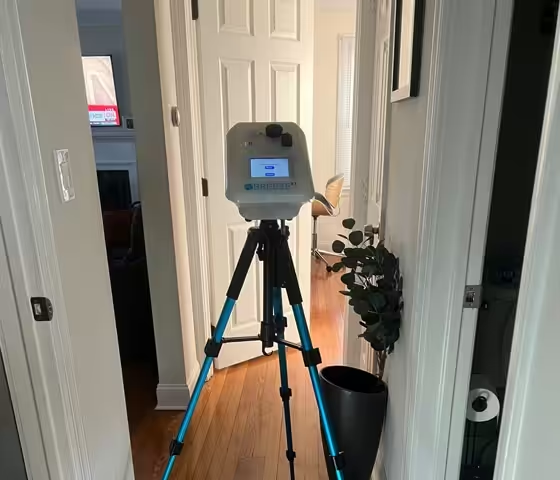
Buying a home is a major investment, and mold or indoor air quality concerns are not always obvious during a standard home inspection.
Mold / Indoor Air Quality Testing adds EPA-approved laboratory testing to your inspection, providing additional information about the home’s indoor environment before you close.
Why Buyers Add Mold / IAQ Testing
- Goes beyond a visual inspection with professional sampling and laboratory analysis.
- Can identify airborne fungal spores that cannot be identified through a visual home inspection alone.
- Adds another layer of due diligence when evaluating a home before purchase.
- Especially valuable when moisture is a concern, including previous leaks, water damage, musty odors, or unknown property history.
- Completed with your home inspection, helping avoid a separate visit if concerns are discovered.
Should I Add It?
Consider adding Mold / IAQ Testing if you want a more complete understanding of the home’s indoor environment before closing.
It may be particularly valuable if the property has a history of leaks or water damage, visible moisture concerns, musty odors, HVAC or condensate issues, previous repairs, or an unknown maintenance history.
Many buyers also choose testing without a specific concern simply because they prefer having the additional information available during their inspection period.
Bottom line: A home inspection provides valuable information about the visible condition of the property. Mold / IAQ Testing adds laboratory data about the indoor environment that the home inspection alone cannot provide.
Isn’t Mold Already Checked During My Home Inspection?
Your home inspector evaluates readily accessible areas of the property and may identify conditions such as:
- Visible moisture staining
- Elevated moisture readings
- Active or suspected leaks
- Musty odors
- Visible microbial-like growth
- HVAC or condensate concerns
- Evidence of previous water intrusion
However, a standard home inspection does not include laboratory testing and cannot determine what may be present in the indoor air.
This is where Mold / IAQ Testing provides additional information.
What Does Mold / IAQ Testing Include?
Mold / IAQ testing involves collecting samples from the home and submitting them to an independent laboratory for analysis.
Indoor air samples can provide information about the types and concentrations of airborne fungal spores present in sampled areas at the time of testing.
When visible suspect microbial growth is present, additional surface sampling may also be appropriate.
The laboratory results are then considered along with conditions observed at the property to provide a more complete picture of the indoor environment.
Can a Home Have a Mold Concern Without Visible Mold?
Yes.
Moisture and microbial growth are not always readily visible. Concerns can sometimes exist in concealed or difficult-to-access locations, particularly when a property has experienced previous leaks or water intrusion.
Testing does not allow us to see inside walls or other concealed areas. However, it provides another source of information that may indicate whether additional investigation is warranted.
This is one reason some buyers choose testing even when the home appears to be well maintained.
Why Is This Particularly Relevant in Central Florida?
Central Florida’s climate creates persistent moisture-management challenges.
High humidity, frequent heavy rainfall, roof leaks, plumbing leaks, HVAC condensate problems, storm-related water intrusion, and other conditions can introduce unwanted moisture into a home.
When moisture remains undiscovered or is not properly corrected, it can create conditions conducive to microbial growth.
For a buyer, identifying concerns during the inspection period provides an opportunity to better understand the property before taking ownership.
What Happens if the Results Identify a Concern?
An abnormal laboratory result does not automatically mean you shouldn’t purchase the home.
Instead, the results provide additional information you can use during your due-diligence period.
Depending on the findings and conditions observed, you may choose to investigate a potential moisture source, obtain additional professional evaluation, or better understand potential remediation needs before closing.
The goal is not to pass or fail the house. The goal is to give you better information before you make the purchase.
Indoor Air Quality Sample Report
Does Testing Guarantee There Is No Mold?
No.
No mold or indoor air quality assessment can guarantee that every concealed condition will be discovered.
Mold can exist in inaccessible areas, and indoor environmental conditions can change over time. Sampling represents conditions in the areas tested at the time of the assessment.
Laboratory results are therefore considered together with the visual assessment, moisture measurements, property conditions, and other available information.
Is Mold / IAQ Testing Worth Adding?
There isn’t one answer that applies to every buyer or every property.
If there are known moisture concerns, previous water damage, musty odors, HVAC issues, or uncertainty about the property’s history, testing can provide valuable additional information.
But you don’t need to wait until a problem is visible to choose testing.
If having additional information about the home’s indoor environment would help you feel better informed about your purchase, Mold / IAQ Testing is worth considering as part of your inspection.