
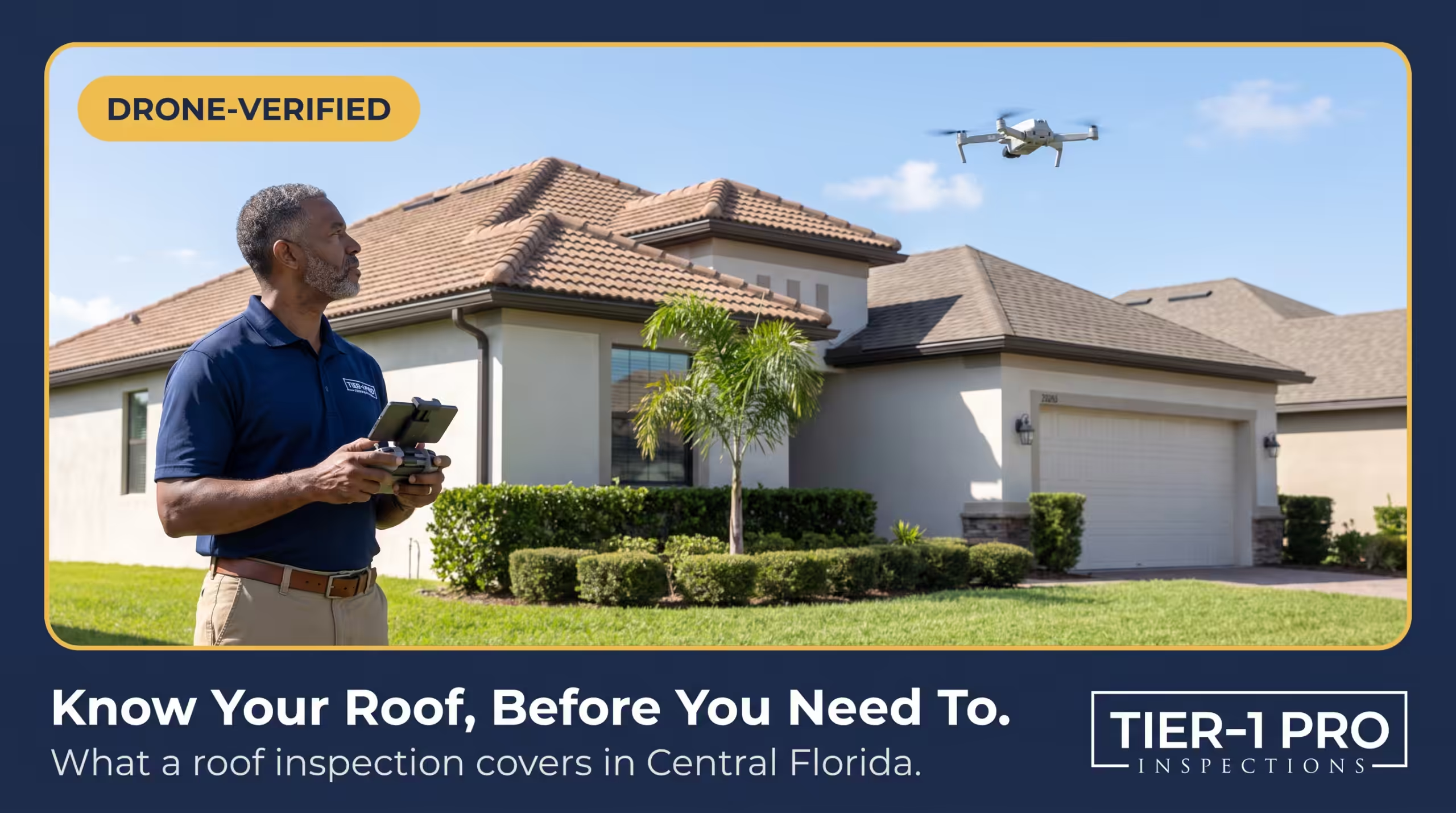
Roof Inspection in Central Florida
-
Typical Cost: Angi reports that in Orlando a basic physical roof inspection runs $80 to $205, a detailed infrared roof inspection runs $410 to $610, and homeowners spend an average of $128 across all methods. A roof evaluation included inside a full home inspection is not billed separately.
-
What Gets Checked: Covering material, flashing, penetrations, drainage, decking movement, attic ventilation and the underside of the roof structure where accessible — plus any visible sign of active water entry.
-
Florida Insurance Rule: Under Florida Statute 627.7011, an insurer cannot refuse to write or renew a policy solely because of roof age when the roof is under 15 years old, and at 15 years or older the homeowner may obtain an inspection showing 5 or more years of useful life remaining.
-
Best Timing: Before you close, before hurricane season, after a named storm, and again as your covering approaches the end of its service life.
-
Why a Neutral Inspector: A home inspector does not sell roofs. Tier-1 Pro Inspections evaluates the roof with drone imagery and infrared thermal imaging and delivers a same-day digital report you can hand to a contractor or an underwriter.
A buyer stands in the driveway of a 2003 block home off Tuskawilla Road in Winter Springs, looking up at three-tab shingles that have gone chalky at the edges. The listing says “roof in good condition.” The seller’s agent says the same. Neither statement tells the buyer whether the underwriter will write a policy on it in six weeks.
That gap — between what the roof looks like from the ground and what it will actually cost you to own and insure — is what a roof inspection closes. This article answers the two questions people search for most: what a roof inspection in Central Florida costs, and what it actually covers when a neutral third party does it.
Tier-1 Pro Inspections is a multi-inspector firm working Orange, Seminole, Lake and Volusia counties from Winter Springs. Owner Sean Richards is a Certified Master Inspector and a 20-year U.S. Army veteran, and the discipline that came out of that career shows up as one thing on a roof: a repeatable order of operations, every time.
How much does a roof inspection cost in Florida, and what changes the price?
The Short Answer:
A roof inspection is a documented condition assessment of the covering, flashing, drainage and structure. Angi reports that in Orlando a basic physical roof inspection runs $80 to $205, a detailed infrared roof inspection runs $410 to $610, and the all-method average is $128. Angi also puts the average full home inspection at $344. Roof size, pitch, height, covering type and imaging method drive the variance.
Why the price range is so wide
The spread between a two-figure ground-level look and a six-hundred-dollar infrared survey is not markup. It is scope. A visual condition check answers whether the roof is failing now, while a thermal survey looks for temperature differentials that suggest moisture held in the assembly.
Thumbtack reports that physical roof inspections average $75 to $200 nationwide while drone inspections average $150 to $400, and that a Winter Springs professional charges a flat $150 for a one-story roof and $200 for two stories. Height and access are the reason that second number exists. A two-story hip roof in Oviedo takes longer to document safely than a single-story ranch in Apopka.
Cost Drivers, In Order of Impact
-
Roof Area and Complexity: More squares and more valleys mean more inspection points. A cut-up roof with six dormers takes materially longer than a simple gable.
-
Height and Access: Two-story and steep-pitch roofs shift the work toward drone imagery. Thumbtack’s Winter Springs figures show the one-story to two-story step directly.
-
Covering Type: Concrete tile and metal need a different eye than asphalt shingle. Tile requires assessment without traffic damage to the tiles themselves.
-
Imaging Method: Angi’s Orlando figures separate a basic physical inspection from a detailed infrared inspection by several hundred dollars, because thermal work takes a longer window and produces a longer report.
-
Standalone Versus Bundled: When the roof is evaluated as part of a full home inspection, it is inside that fee rather than beside it. Angi puts the average full home inspection at $344, with a range of $296 to $424.
Where a roof inspection sits inside a full home inspection
Most Central Florida buyers do not buy a roof inspection on its own. They buy a full residential home inspection and the roof is one system inside it, evaluated to the same written standard as the electrical panel and the water heater.
Under the InterNACHI Standards of Practice, an inspector is not required to walk any roof surface — the roof may be inspected from ground level or the eaves — but the inspector must report observed indications of active roof leaks as in need of correction. That is the floor, not the ceiling. Drone imagery lets Tier-1 document a surface at close range without adding foot traffic to a covering that may already be brittle.
What the standards actually require of an inspector
The two national standards bodies organize the work differently and both matter here. The ASHI Standard of Practice is sequenced the way inspectors actually move through a property — Structure, Exterior, Roofing, Plumbing, Electrical, HVAC, Interior, Insulation, Ventilation — and in its newly approved version Insulation and Ventilation are split into separate sections, with a new section added for the use of specialized tools and equipment.
That last addition matters for roofs specifically, because drone and thermal work is exactly the specialized-tool category. ASHI also defines “unsafe” as a condition in a readily accessible installed component that the inspector judges to present a significant risk of serious bodily injury in normal day-to-day use. InterNACHI’s standards relieve the inspector of any duty to do something unsafe, including walking a roof surface, climbing a ladder or entering an attic.
When a roof inspection is not the right purchase
Be honest about scope. If your roof has already failed visibly — daylight through the decking, an active drip during a Volusia County afternoon storm — you need a licensed roofing contractor for a repair estimate, not a condition report. Verify the contractor’s license through the Florida Department of Business and Professional Regulation.
A roof inspection also does not substitute for a wind mitigation inspection, which is a separate insurance-specific form with its own required photographs and questions. The two are complementary, not interchangeable.
When should you get a roof inspection in Central Florida?
The Short Answer:
Schedule a roof inspection before closing on a purchase, before listing a home, ahead of hurricane season, after any named storm passes over Orange, Seminole, Lake or Volusia counties, and when your covering nears the end of its service life. Florida Statute 627.7011 makes the 15-year mark a specific decision point for insurance, since an inspection showing 5 or more years of useful life protects coverage.
The insurance timeline every Florida owner should know
Roof age is the single most consequential number on a Florida homeowner’s policy application. Under Florida Statute 627.7011, an insurer may not refuse to issue or renew a policy on a residential structure with a roof less than 15 years old solely because of roof age. Once the roof reaches 15 years, the insurer must allow the homeowner to obtain an inspection from an authorized inspector, at the homeowner’s expense, before requiring replacement.
If that inspection shows 5 years or more of useful life remaining, the insurer cannot refuse coverage on roof age alone. That single sentence is why owners of 2009-and-earlier roofs in Deltona, Sanford and Clermont book condition inspections every renewal cycle.
Service Life by Covering Type
-
Three-Tab Asphalt Shingle: Tier-1’s component life-expectancy guide lists 20 years. In practice these are the roofs that hit the 627.7011 conversation first.
-
Architectural Shingle: Listed at 30 years. Heavier, more layered, and generally holding granules longer than three-tab under the same sun exposure.
-
Metal: Listed at 40 to 80 years. The failure point is usually fasteners, seams and flashing rather than the panel itself.
-
Tile and Clay: Listed at 100 or more years for the tile. The underlayment beneath it does not last that long, which is the finding most tile owners are surprised by.
Compare those numbers against the age on the permit and you have a rough read on where you sit. Our component life expectancy reference covers the rest of the house on the same basis.
What the inspection sequence actually looks like
-
Step One — Ground Perimeter: A full walk of the exterior, reading the roof planes from below and checking gutter and downspout discharge, fascia, soffit and any sagging in the roof line.
-
Step Two — Drone Overflight: Close-range imagery of every plane, valley, ridge, hip, plumbing boot, vent stack and chimney flashing, captured as photographs that go into the report.
-
Step Three — Penetration Review: Each penetration is the most common water entry point on a Central Florida roof, so boots, collars and counterflashing get individual attention.
-
Step Four — Attic and Underside: Where accessible and safe, the underside of the decking tells the truth the top surface hides — staining patterns, rusted nail shanks, daylight and compressed or displaced insulation.
-
Step Five — Infrared Scan: Thermal imaging looks for temperature differentials consistent with retained moisture, which frequently shows a problem before a ceiling stain does.
-
Step Six — Same-Day Digital Report: Findings, photographs and plain-language explanations delivered the same day so you can act inside your inspection period.
Real-World Field Scenarios
-
Sanford Bungalow, 22-Year-Old Three-Tab: A buyer under contract near Lake Monroe learns the covering is two years past its listed 20-year service life. The inspection report gives the buyer something specific to bring to the negotiation and gives the underwriter a documented condition, rather than a guess.
-
Kissimmee Short-Term Rental, Post-Storm: After a named storm tracks across Osceola and south Orange, an owner needs to know whether wind lifted shingles on the rear plane before the next guest checks in. Drone imagery documents the condition without adding foot traffic.
-
New Smyrna Beach Coastal Metal Roof: Salt air near the Halifax works on fasteners and seams long before the panels themselves give up. The finding is almost always at the connections.
-
Clermont Tile Roof, Original Underlayment: The clay is fine. The underlayment beneath it, installed with the house, is the component actually approaching failure — a distinction that changes the repair conversation entirely.
-
Altamonte Springs Pre-Listing: A seller books a pre-listing inspection to find the flashing issue before a buyer’s inspector does, then repairs it and lists with documentation in hand.
Roof age, wind mitigation and the discount you may be leaving on the table
Florida’s Uniform Mitigation Verification Inspection Form, OIR-B1-1802, is valid for up to five years provided no material changes are made to the structure and no inaccuracies are found, according to the Florida Office of Insurance Regulation. The same office notes that Section 627.0629 has required all residential property insurers, effective October 1, 2023, to describe available hurricane mitigation discounts on their websites.
Roof covering, roof deck attachment, roof-to-wall connection and secondary water resistance are all wind mitigation line items. If you are already scheduling a condition inspection, ask whether a wind mitigation form makes sense at the same visit.
Why a neutral inspector reads the roof differently
Most roof inspection results in Central Florida come from companies that also sell roofs. That is not an accusation; it is a structural conflict worth naming. A home inspector has no product to sell after the report is delivered, and that changes what “needs attention” means.
According to the National Association of REALTORS Confidence Index Survey, 20% of buyers waived the inspection contingency in December 2024, down from 22% a month earlier and 24% a year earlier. Fewer buyers are going in without eyes on the property, and the roof is the system where that decision carries the most weight in Florida.
Key Takeaways
-
Cost Is Scope-Driven: Angi’s Orlando figures span $80 to $205 for a basic physical roof inspection and $410 to $610 for detailed infrared, with an all-method average of $128 — the method you choose sets the price.
-
Fifteen Years Is the Legal Hinge: Florida Statute 627.7011 protects roofs under 15 years from age-based refusal, and lets older roofs qualify through an inspection showing 5 or more years of useful life.
-
Standards Set the Floor: InterNACHI does not require an inspector to walk a roof, but does require reporting observed indications of active leaks, and ASHI’s newly approved standard adds a dedicated section for specialized tools.
-
Covering Type Sets Expectations: Three-tab at 20 years, architectural at 30, metal at 40 to 80 and tile at 100-plus — with tile underlayment aging far faster than the tile above it.
-
Neutrality Is the Differentiator: An inspector who does not sell roofs gives you a condition report you can hand to a contractor, an agent or an underwriter without discounting it.
Schedule a Roof Inspection in Orange, Seminole, Lake or Volusia County
Tier-1 Pro Inspections evaluates roofs with drone imagery and infrared thermal imaging as part of our residential and commercial property inspection work, and delivers a same-day digital report written to be understood rather than decoded. We are veteran-owned, hold Certified Master Inspector credentials, and carry more than 1,000 five-star reviews across Central Florida.
Tell us the address, the roof age if you know it, and whether this is a purchase, a listing or a renewal question. You can book an inspection online, reach the office through our contact page, or call (407) 670-0891. If you are still comparing options, our list of inspection services shows what pairs well with a roof evaluation.
External References
-
International Association of Certified Home Inspectors — Standards of Practice governing what a home inspector must inspect and report.
-
American Society of Home Inspectors — Standard of Practice, including definitions of unsafe conditions and specialized equipment use.
-
Florida Building Commission — Florida Building Code requirements affecting roof assemblies and replacement.
-
Florida Department of Business and Professional Regulation — License verification for roofing contractors and home inspectors.
-
National Oceanic and Atmospheric Administration — Hurricane season timing and storm track information for Central Florida.