
Manufactured and mobile homes represent a significant and often underserved segment of Central Florida’s housing market. In Lake, Volusia, Osceola, and the outer areas of Orange County, manufactured housing isn’t a niche product — it’s a primary ownership option for a large population of buyers who need an affordable path to homeownership in a market where site-built home prices have moved well beyond reach for many households. What those buyers frequently discover when they get into a transaction is that financing, insuring, and inspecting a manufactured home involves a set of requirements that are meaningfully different from what applies to a conventional site-built home, and that discovering those differences mid-transaction rather than going in prepared is where deals fall apart and buyers get hurt.
The terminology itself creates confusion before anything else does. The terms manufactured home, mobile home, and modular home are used interchangeably in casual conversation but refer to legally and structurally distinct categories of housing that are treated differently by lenders, insurers, and inspectors. The core distinctions are:
- A mobile home is technically a unit built before June 15, 1976, the date on which the federal HUD Manufactured Home Construction and Safety Standards — universally known as the HUD Code — took effect and permanently changed how this category of housing is built and regulated.
- A manufactured home is a unit built after that date to HUD Code standards, constructed entirely in a factory on a permanent steel chassis, and transported to the installation site.
- A modular home is factory-built in sections but constructed to the same state building code as a site-built home, transported to the site, and assembled on a permanent foundation.
Modular homes, once assembled and affixed to their foundation, are generally treated by lenders and insurers as equivalent to site-built construction. Manufactured and mobile homes are not, and the inspection requirements they carry reflect that distinction.
What the HUD Code Governs and Why It Matters for Inspections
The HUD Manufactured Home Construction and Safety Standards established in 1976 set federal requirements for the design, construction, strength, durability, transportability, fire resistance, energy efficiency, and quality of manufactured homes. Every manufactured home built to HUD Code carries a HUD certification label — a small metal plate affixed to the exterior of each section of the home — that certifies it was built in compliance with the federal standard. That label is not a decorative feature. It is a prerequisite for financing with most conventional lenders, for FHA and VA loan eligibility, and for many insurance carriers. A manufactured home without a legible, intact HUD label creates immediate problems for any transaction involving financing or insurance, and resolving a missing label situation requires a formal verification process through the Institute for Building Technology and Safety that adds time and cost to the transaction.
A manufactured home inspection evaluates the home against both the HUD Code standards applicable at the time of construction and the current condition of the home’s systems and structure. The scope of the inspection overlaps substantially with a standard home inspection — roofing, electrical, plumbing, HVAC, interior and exterior — but the specific items evaluated and the standards they’re evaluated against reflect the manufactured housing context rather than the site-built context. Roof-over systems, which are common on older manufactured homes and involve a second roof structure built over the original factory roof, are evaluated differently than a conventional roof because their construction, attachment, and drainage dynamics are specific to the manufactured housing form. Electrical systems in manufactured homes use a different wiring standard than site-built homes — aluminum wiring is more common and the panel configuration differs — and an inspector who applies site-built electrical evaluation criteria to a manufactured home without understanding those differences will generate findings that are technically inaccurate. Working with an inspector who has specific experience in manufactured home evaluation is not a preference but a practical necessity for getting a report that accurately describes the home’s condition.
The Tie-Down and Foundation Inspection: Why Lenders and Insurers Require It
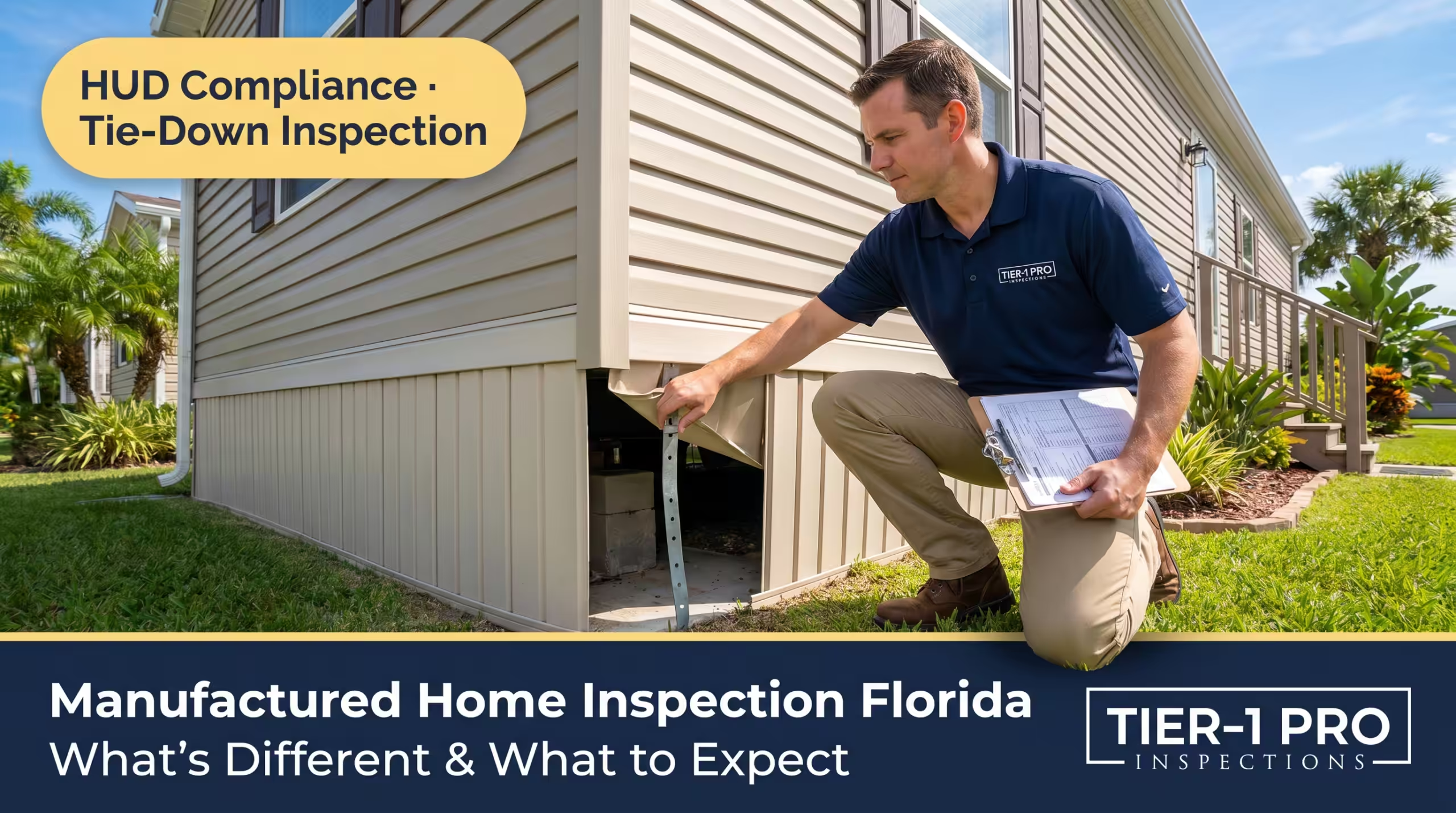
Of all the inspection components specific to manufactured housing, the tie-down and foundation evaluation is the one most likely to determine whether a transaction can proceed at all. Manufactured homes are secured to their installation site through a system of anchors, straps, and piers that transfer the home’s load to the ground and resist the lateral and uplift forces that wind events generate. In Florida — a state with a well-documented history of manufactured home communities experiencing catastrophic wind damage during hurricane events — the adequacy of this system is treated as a serious structural and safety question by lenders, insurers, and regulators alike.
Florida requires manufactured home tie-down systems to meet standards established by the Florida Department of Highway Safety and Motor Vehicles and, for homes in wind-designated zones, the additional requirements of the Florida Building Code. What those standards require in practice depends on the wind zone classification of the location where the home is installed, the size and age of the home, and the soil conditions at the site. A home in a Wind Zone II or Wind Zone III area — the classifications that apply to most of coastal and south-central Florida — must meet more stringent anchorage requirements than a home in Wind Zone I. An inspector verifying tie-down compliance isn’t just checking whether straps are present. They’re evaluating:
- The type, spacing, and condition of the anchors
- The configuration and load-bearing capacity of the piers supporting the home’s steel chassis
- The condition of the straps and their connection hardware
- Whether the overall system meets the requirements applicable to that specific home in that specific location
For buyers financing a manufactured home with an FHA or VA loan, a HUD compliance certification from an engineer or licensed inspector is a loan requirement. The certification confirms that the tie-down system and foundation meet HUD standards and that the home is properly supported and anchored for its installation site. Without this certification, FHA and VA loans cannot close. Conventional lenders typically have their own requirements that parallel the FHA/VA standard. This means the tie-down and foundation inspection isn’t an optional add-on for buyers using financing — it’s a mandatory deliverable in the loan package, and its outcome can require remediation before the loan can proceed.
Pier condition and spacing are among the most common findings in manufactured home foundation evaluations in Central Florida. Piers that have settled, cracked, or shifted create uneven load distribution that over time produces floor sagging, wall racking, door and window misalignment, and in serious cases structural damage to the home’s chassis. Older homes where the original piers were inadequately sized or spaced for the home’s weight, or where soil conditions have changed since installation, frequently require pier additions or replacements to meet current standards. Strap and anchor hardware that has corroded, loosened, or been damaged over time needs replacement. These aren’t cosmetic issues — they’re the structural foundation of a home type that depends on its anchorage system in a way that site-built homes simply don’t, and their condition is what determines whether the home will perform as intended when Florida weather tests it.
Roof-Over Systems and Exterior Evaluation
A large proportion of manufactured homes in Central Florida that were built before the 1990s have had roof-over systems installed at some point during their service life. A roof-over is essentially a second roof structure — typically a low-slope metal or shingle system — built over the original factory-installed roof rather than replacing it. The motivation is usually to stop leaks in an aging original roof or to improve the home’s resistance to wind-driven rain without undertaking a full roof replacement, and in many cases it has extended the useful life of homes that would otherwise have developed serious moisture problems. The inspection challenge they present is that a roof-over creates a concealed space between the original roof surface and the new structure above it, and that space is where moisture problems develop invisibly. Water that gets under the new roof at a flashing failure or a penetration can saturate the original roof material and the underlying decking without producing visible interior symptoms for an extended period, by which time the damage behind the ceiling panels is already significant.
Inspectors evaluate roof-over systems for the condition and integrity of the outer roofing material and its installation, the condition of flashing at all penetrations and perimeter transitions, the drainage system’s ability to manage water away from the home, and any visible evidence of moisture at the ceiling or wall interfaces that might indicate a failure beneath the visible surface. Thermal imaging is particularly useful in roof-over situations because it can identify temperature differentials produced by moisture accumulation in the concealed space that a visual inspection alone cannot detect.
The exterior of a manufactured home — siding, fascia, windows, doors, and skirting — is evaluated for condition, integrity, and evidence of moisture intrusion. Vinyl siding on older manufactured homes has a finite lifespan and becomes brittle with age and UV exposure, and damaged or missing sections create direct water infiltration pathways. Skirting — the material that encloses the space between the home’s bottom and the ground — is evaluated for condition and for whether it provides adequate access to the undercarriage while maintaining the pest and moisture exclusion it’s designed to provide. The undercarriage itself, the insulated belly wrap that encloses the home’s floor system, is inspected for damage, moisture staining, and evidence of pest intrusion, because damage to the belly wrap compromises the insulation of the floor system and creates conditions where plumbing in the undercarriage is exposed to temperature extremes.
Insurance Considerations for Manufactured Homes in Florida
Insuring a manufactured home in Florida is a more complicated undertaking than insuring a site-built home, and buyers who assume the process will work the same way typically encounter their first surprise when they call for quotes. The standard homeowners insurance market for manufactured housing is narrower than for site-built construction, with fewer carriers willing to write coverage and more specific eligibility requirements around the home’s age, HUD compliance status, tie-down system, and location. Manufactured homes in Florida’s coastal counties and wind-designated areas face the most constrained insurance environment, where coverage may be limited, priced at a significant premium relative to a comparable site-built home, or conditioned on tie-down upgrades or other improvements.
Age is a significant factor in manufactured home insurability in Florida. Homes built before 1976 — mobile homes in the strict technical sense — are the most difficult to insure because they predate HUD Code and carry no federal compliance documentation. Many standard carriers won’t write coverage on pre-1976 units at all, and those that will typically require a full inspection and may apply significant limitations. Homes built after 1976 with intact HUD labels are in a better position, but older post-HUD homes still face underwriting scrutiny around roof age, tie-down compliance, and electrical system condition that reflects the insurance market’s experience with this housing type in Florida’s weather environment. A four point inspection for a manufactured home follows the same general structure as for a site-built home — roof, electrical, plumbing, HVAC — but is evaluated against manufactured housing standards, and the outcome of that inspection is the primary document an insurer uses to make coverage decisions.
Buyers who are serious about purchasing a manufactured home in Central Florida are well-served by contacting their insurance agent before rather than after going under contract, to understand what the coverage options look like for the specific home they’re considering and what, if any, conditions will need to be satisfied before a policy can be bound. Discovering at closing that a home is uninsurable or that coverage is significantly more expensive than budgeted for is a preventable problem when the conversation happens at the right point in the process.
People Also Ask
What is the difference between a manufactured home, mobile home, and modular home?
A mobile home is a factory-built unit constructed before June 15, 1976, prior to the HUD Code taking effect. A manufactured home is a factory-built unit constructed after that date to HUD federal standards, installed on a permanent steel chassis. A modular home is factory-built in sections but constructed to state building code standards and assembled on a permanent foundation, making it legally equivalent to site-built construction for most financing and insurance purposes. The distinction matters significantly for lenders, insurers, and inspectors.
What is a HUD label and why does it matter?
The HUD certification label is a small metal plate affixed to the exterior of each section of a manufactured home, certifying that it was built in compliance with the HUD Manufactured Home Construction and Safety Standards. It is a prerequisite for FHA and VA financing, required by most conventional lenders, and a factor in manufactured home insurance eligibility. A manufactured home with a missing or illegible HUD label requires a formal verification process through the Institute for Building Technology and Safety to resolve the documentation gap.
What does a manufactured home tie-down inspection evaluate?
The tie-down inspection evaluates the anchors, straps, and piers that secure the manufactured home to its site and resist wind uplift and lateral forces. The inspector assesses anchor type, spacing, and condition; pier configuration, load capacity, and condition; strap and connection hardware; and whether the overall system meets the requirements applicable to the home’s wind zone classification and size. For FHA and VA loans, a HUD compliance certification confirming the tie-down system meets federal standards is a required loan document.
Are manufactured homes harder to insure in Florida?
Yes, generally. The standard homeowners insurance market for manufactured housing in Florida is narrower than for site-built homes, with specific eligibility requirements around HUD compliance, tie-down systems, roof age, and location. Pre-1976 mobile homes are the most difficult to insure. Homes in wind-designated coastal areas face additional constraints. Buyers should contact an insurance agent before going under contract to understand coverage options and costs for the specific home being considered.
Does a manufactured home need a four point inspection in Florida?
Yes, if you need homeowners insurance — which is required for any financed purchase. The four point inspection for a manufactured home follows the same general structure as for a site-built home, covering roof, electrical, plumbing, and HVAC, but is evaluated against manufactured housing standards. The outcome of the four point inspection is the primary document an insurance carrier uses to make coverage and pricing decisions for a manufactured home.
What is a roof-over system on a manufactured home?
A roof-over is a second roof structure built over the original factory-installed roof rather than replacing it, typically installed to address leaks in an aging original roof or improve weather resistance. Roof-overs are common on older Central Florida manufactured homes. They create a concealed space between the original and new roof surfaces where moisture problems can develop without producing visible interior symptoms, making thorough flashing and ceiling inspection — and ideally thermal imaging — important parts of evaluating a home with a roof-over system.