
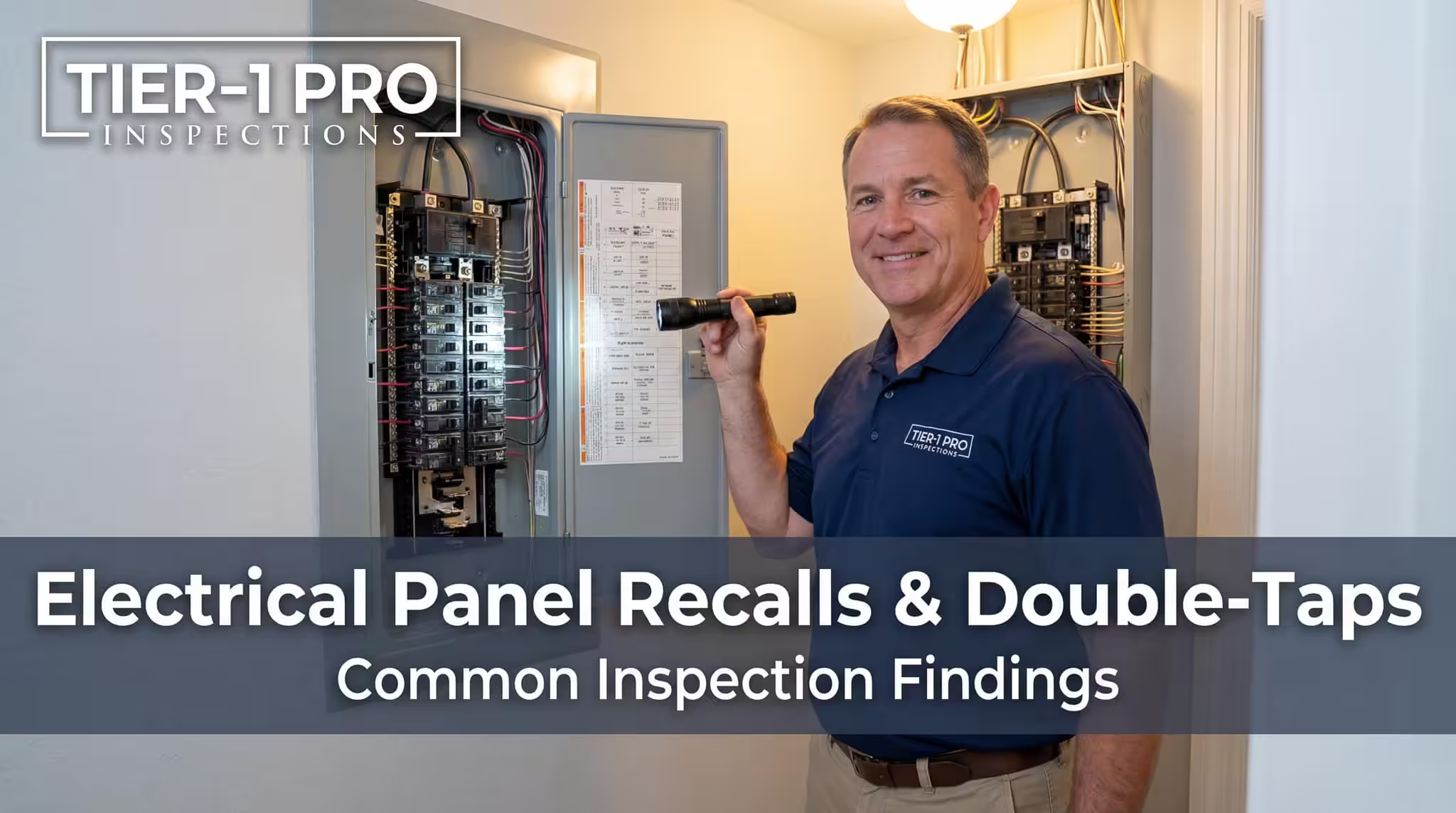
When a home inspector opens an electrical panel in Central Florida, two findings show up on reports more than almost anything else: breaker double-taps and recalled panel brands. Neither one is something to dismiss. Both carry real safety implications — and both are negotiating points that buyers can and should use.
This article explains what these deficiencies are, why they’re flagged, which panel brands have the worst track records, and what your options are when they appear on your inspection report.
What Is a Breaker Double-Tap?
A breaker double-tap occurs when two or more electrical conductors (wires) are connected to a single circuit breaker terminal that is only rated and designed for one. The breaker is doing the job of two — and it wasn’t built to do that.
Quick answer: Most residential circuit breakers are designed to accept a single wire. When two wires share one breaker terminal, it creates a loose connection that can arc, overheat, and in serious cases, cause an electrical fire.
Why Double-Taps Happen
Double-tapping is almost never intentional malice — it’s usually a shortcut taken when a panel runs out of available breaker slots. Rather than installing a subpanel or upgrading the main panel, an electrician (or a homeowner attempting DIY work) adds a second wire to an existing breaker instead of adding a new one. It’s faster, cheaper, and wrong.
In Central Florida’s active renovation and addition market, double-taps are especially common in homes that have had rooms added, HVAC systems upgraded, or kitchens remodeled without a corresponding panel upgrade.
The Exception: Tandem-Rated Breakers
Not every two-wire configuration is a deficiency. Some breakers are specifically manufactured and listed to accept two conductors — these are called tandem breakers or duplex breakers, and the panel’s directory will indicate where they’re permitted. The critical distinction is whether the breaker is listed for two conductors. If it is, that’s acceptable. If it isn’t, it’s a double-tap regardless of how neatly the wires are connected.
Inspectors verify this by checking the breaker’s labeling and the panel’s manufacturer directory. A standard single-pole breaker with two wires crammed into the terminal is a deficiency even if it has held that way for twenty years without incident.
What Inspectors Look for Inside an Electrical Panel
Electrical panels are one of the highest-value areas of a home inspection. Beyond double-taps, a qualified inspector will evaluate:
- Panel brand and known recall status
- Double-tapped breakers and neutral bars
- Breaker condition — signs of overheating, scorching, or corrosion
- Wire gauge vs. breaker amperage — mismatched combinations are a fire hazard
- Aluminum branch wiring (common in homes built between the mid-1960s and mid-1970s)
- Open knockouts — gaps in the panel enclosure that expose live components
- Panel labeling accuracy — unlabeled or mislabeled circuits are a safety and maintenance concern
- Main disconnect condition and accessibility
- GFCI and AFCI protection where required by current code
Recalled Electrical Panels: The Ones Inspectors Flag Most
Certain panel brands have well-documented histories of defects, fires, and formal recalls or advisories. In Central Florida homes, inspectors encounter these regularly — especially in homes built between the 1950s and 1990s.
Federal Pacific Electric (FPE) Stab-Lok Panels
Federal Pacific Electric panels with Stab-Lok breakers are among the most widely discussed safety concerns in residential home inspection. These panels were installed in millions of American homes from the 1950s through the 1980s and are still found regularly in Central Florida’s older housing stock.
The core problem: Stab-Lok breakers have been shown in independent testing to fail to trip during overload conditions at a significantly higher rate than code requires. A breaker that doesn’t trip when it should is a breaker that allows wires to overheat — which is how electrical fires start inside walls.
The Consumer Product Safety Commission (CPSC) investigated these panels. While a formal mandatory recall was never issued, the body of evidence accumulated over decades — fire investigations, engineering studies, and insurance industry data — has led most professional home inspection associations and insurance underwriters to treat FPE Stab-Lok panels as a significant safety concern warranting evaluation and likely replacement.
What buyers should do: If an FPE Stab-Lok panel is identified during inspection, consult a licensed electrician for a full evaluation. Many insurance carriers in Florida will decline coverage or require replacement before binding a homeowner’s policy.
Zinsco (and GTE-Sylvania Zinsco) Panels
Zinsco panels, also sold under the GTE-Sylvania brand, share a similar profile to FPE. Installed widely from the 1950s through the 1970s, Zinsco breakers have a documented tendency to fail to trip on overload and, in some cases, to physically melt and fuse to the bus bar — making them impossible to manually switch off. A breaker you can’t turn off in an emergency is not a functional safety device.
Like FPE, Zinsco panels are not subject to a mandatory recall but are widely flagged by inspectors, rejected by insurers, and recommended for replacement by licensed electrical contractors.
Pushmatic Panels (ITE/Bulldog)
Pushmatic panels — branded under ITE or Bulldog — use a push-button breaker mechanism rather than the toggle switches found in modern panels. The panels themselves are not under a formal recall, but they present practical and safety challenges: the breakers are no longer manufactured, replacement parts are difficult to source, the mechanism can stick (preventing proper reset), and the panels lack a main disconnect in many configurations.
Inspectors flag Pushmatic panels not because they are categorically unsafe in the way FPE and Zinsco are, but because their age, obsolete components, and maintenance limitations make them a liability in a modern home.
Challenger Panels
Challenger panels, manufactured primarily in the 1980s and early 1990s, have been associated with breaker defects and in some cases fires. They are less universally condemned than FPE or Zinsco but are frequently flagged by inspectors and reviewed carefully by insurers, particularly in Florida.
Double-Tapped Neutral Bars: The Other Side of the Problem
A breaker double-tap gets most of the attention, but double-tapped neutral bars are equally worth noting. The neutral bar (also called the grounded conductor terminal bar) runs along the interior of the panel and accepts the white neutral wires from each circuit. Like breakers, each terminal on a neutral bar is typically rated for one conductor.
When two neutral wires are stuffed into a single terminal, it creates the same loose-connection risk: arcing, heat buildup, and potential for fire. Home inspectors evaluate neutral bar connections as part of a complete panel inspection, and double-tapped neutrals are a reportable deficiency just as double-tapped breakers are.
Why This Comes Up So Often in Central Florida
Central Florida’s housing market has a wide age range. The Orlando metro, Kissimmee, Clermont, and surrounding communities include substantial housing stock from the 1960s, 70s, and 80s — exactly the era when FPE, Zinsco, and Pushmatic panels were being installed. It’s not unusual for a home inspection in Ocoee, Apopka, or Winter Garden to turn up one of these panel brands, particularly in homes that have changed hands several times without a full electrical update.
Add to that the frequency of renovations and additions in the region — pools, enclosed lanais, added bedrooms, upgraded HVAC — and you have a predictable recipe for double-tapped breakers in panels that were never expanded to accommodate the additional load.
What Buyers Should Do When These Issues Appear on an Inspection Report
If a Double-Tap Is Found
A double-tap finding is a legitimate repair request. The fix is straightforward for a licensed electrician: either install a tandem breaker where the panel allows it, relocate one circuit to an available breaker slot, or install a small subpanel if the main panel is genuinely at capacity. This is not a catastrophically expensive repair in most cases — but it should be done by a licensed electrician, not a handyman.
Request the repair before closing, or negotiate a credit to cover the work after closing. Either is reasonable. What you shouldn’t do is accept “it’s been fine for years” as an answer.
If a Recalled or Problematic Panel Brand Is Found
This is a larger conversation. Depending on the panel brand, age, condition, and your insurance situation, your options are:
1. Negotiate for full panel replacement prior to closing. For FPE Stab-Lok and Zinsco panels especially, many buyers and their agents successfully negotiate a panel replacement as a condition of closing. A panel replacement by a licensed electrician in Central Florida typically runs in the range of $1,500–$3,500 depending on the size of the service and any related work (permit, inspection, updated grounding, etc.).
2. Negotiate a seller credit. If the seller won’t replace it, a documented credit in the amount of a legitimate contractor estimate is reasonable and keeps the project in your hands post-closing.
3. Check with your insurance carrier before closing. This is not optional. Florida homeowner’s insurance underwriters take electrical panel brands seriously. Some carriers will not bind a policy on a home with an FPE or Zinsco panel without a signed agreement to replace it within a defined timeframe. Others decline entirely. Know where you stand before you’re at the closing table.
4. Get an electrician’s evaluation — not just your inspector’s opinion. Home inspectors identify and report; they don’t quote repair costs or make insurance decisions. A licensed electrician’s written evaluation of the panel gives you the documentation you need for negotiating with the seller and for your insurance carrier.
People Also Ask
Is a double-tapped breaker dangerous? It can be. A double-tapped breaker creates a loose connection at the terminal, which can arc and generate heat inside the panel. The risk varies based on the load on those circuits and the condition of the connections, but it’s a code violation and a reportable deficiency in any professional home inspection. It should be corrected by a licensed electrician.
How do I know if my panel is a recalled brand? Look at the panel door and the breakers themselves. FPE panels typically have “Federal Pacific Electric” or “Stab-Lok” markings. Zinsco panels are labeled “Zinsco” or “GTE-Sylvania.” Pushmatic panels have push-button breakers with “Pushmatic,” “ITE,” or “Bulldog” markings. If you’re uncertain, a home inspector or licensed electrician can identify the brand.
Can I get homeowner’s insurance with an FPE or Zinsco panel in Florida? It depends on the carrier. Many Florida insurers will decline coverage outright, require replacement before binding the policy, or add a surcharge. This is one of the most important reasons to address panel concerns before closing rather than after — discovering an uninsurable panel after you own the home puts you in a much weaker negotiating position.
What does it cost to replace an electrical panel in Central Florida? Panel replacement costs vary based on the size of the electrical service (100-amp vs. 200-amp), permit requirements, and any associated work such as grounding electrode upgrades. In the Central Florida market, a full panel replacement by a licensed electrician typically falls in the $1,500–$3,500 range for a standard residential service upgrade. Homes requiring a service entrance upgrade or additional work may run higher.
Are tandem breakers safe? Yes, when used correctly. Tandem breakers are listed for use in specific panel models and must only be installed in slots designated for them in the panel’s load directory. A tandem breaker in a listed slot is code-compliant. The same breaker installed in an unlisted slot, or a standard single-pole breaker with two wires jammed into it, is not.
Does a home inspection check every breaker in the panel? A home inspector will visually examine accessible panel components with the cover removed, including breaker terminals, the neutral bar, wiring conditions, and general panel condition. However, home inspectors do not load-test individual breakers or measure amperage draws. Findings are based on visual examination and the inspector’s professional knowledge of code requirements and common deficiencies.
The Bottom Line
Electrical panels don’t get the same attention as kitchens or roofs during a home purchase, but they should. A breaker double-tap is a correctable deficiency. A recalled panel brand is a larger issue that intersects with your safety, your insurance, and your long-term cost of ownership.
In Central Florida’s housing stock, these findings are common — not because the homes are poorly built, but because electrical standards have evolved significantly over the past forty years and many panels simply haven’t kept pace. A thorough home inspection surfaces these issues before they become your problem after closing.
If your home inspector identifies electrical panel concerns in Orlando, Kissimmee, Ocoee, or anywhere across Central Florida, treat the findings seriously, get an electrician’s written evaluation, and use the information to negotiate from a position of knowledge.