
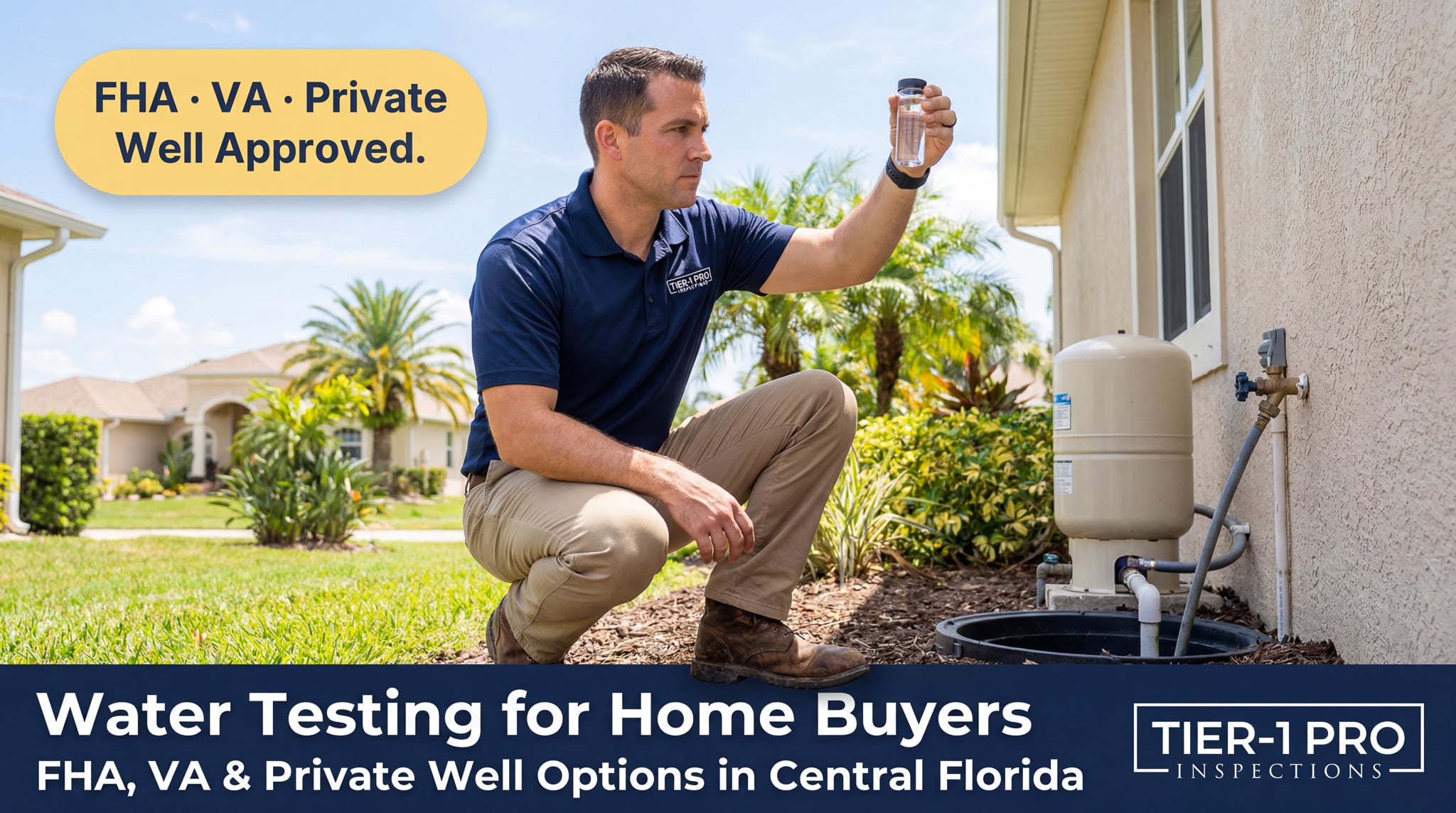
Water quality testing doesn’t come up in most home purchase conversations until it has to — and for a significant number of buyers in Central Florida, it has to. If you’re financing a home with an FHA or VA loan and the property has a private well, water testing isn’t optional. It’s a loan requirement, and the results have to meet federal guidelines before your lender will allow the transaction to close. For buyers using conventional financing or purchasing a home on municipal water, the requirement doesn’t exist in the same mandatory form — but the underlying question of what’s coming out of the taps is worth asking regardless of how the purchase is being financed.
Understanding what water testing covers, why certain loan programs require it, and what the results actually mean is straightforward once you have the context. What follows is that context — the practical information a Central Florida buyer needs to navigate water testing from the inspection period through closing, whether the home is on a municipal supply system, a private well, or a shared well serving a small number of properties.
FHA and VA Loan Requirements
The Federal Housing Administration and the Department of Veterans Affairs both require that water from any non-public source — meaning any private well, shared well, or individual water supply that is not part of a regulated municipal system — meet established potability standards before a loan insured or guaranteed by those agencies can close. This requirement exists because both programs are designed to protect buyers from purchasing homes with conditions that would create immediate health or safety concerns, and contaminated drinking water qualifies as exactly that kind of condition. The lender isn’t creating this requirement independently — it flows from HUD Handbook 4000.1 for FHA loans and from VA Lender Handbook guidelines for VA loans, and it applies uniformly regardless of which lender or which state the transaction is in.
The specific parameters tested and the acceptable thresholds are defined by the EPA’s drinking water standards, which establish maximum contaminant levels for a defined list of biological, chemical, and physical parameters. Testing must be conducted by a state-certified laboratory — not just any water testing service — and the results must be submitted to the lender as part of the loan file. Tier-1 Pro Inspections provides FHA and VA approved water testing as a service, which means the sampling is handled properly, the samples go to a certified lab, and the results come back in a format that satisfies the lender’s documentation requirements. For buyers who try to shortcut this with a home test kit or a non-certified service, the results won’t be accepted and the testing will need to be done again, which costs time in a transaction that already has a closing deadline.
The parameters covered in a standard FHA/VA water test include coliform bacteria and E. coli, nitrates and nitrites, lead, pH, and in some cases additional contaminants based on local known conditions or lender requirements. Each of these tells a different part of the story about the water’s safety and suitability:
- Coliform bacteria — including E. coli — indicate the presence of biological contamination in the water supply, typically from surface water intrusion into the well, a compromised well casing, or proximity to a septic system.
- Nitrates in drinking water above the EPA maximum contaminant level of 10 parts per million are a health concern, particularly for infants and pregnant women, and elevated nitrate levels in Central Florida well water are frequently traceable to agricultural activity, lawn fertilization, or septic system effluent in the surrounding area.
- Lead in drinking water doesn’t come from the well itself but from the plumbing materials inside the home — solder joints in older copper plumbing, brass fixtures, and in rare cases lead service lines — and its presence is relevant for any home regardless of water source.
- pH outside of normal range affects how corrosive the water is to the home’s plumbing and can indicate other chemical imbalances in the supply.
Well Water in Central Florida: The Geographic Context
Central Florida’s relationship with well water is more complicated than most buyers moving to the region from other parts of the country expect. The greater Orlando metro itself — the city, the major suburbs, Kissimmee, and the densely developed communities across Orange and Seminole counties — is served by municipal water systems, and homes in those areas typically aren’t subject to the mandatory FHA/VA water testing requirement. But Central Florida is a large and geographically diverse region, and as you move outward from the urban core into Lake, Volusia, Osceola, and the rural portions of Orange County, private wells become increasingly common. Clermont, Mount Dora, Eustis, Tavares, Deltona, DeLand, and the communities extending into the agricultural and semi-rural areas of those counties have significant private well populations, and buyers purchasing in those markets need to understand what that means.
Florida’s primary drinking water source for well users is the Floridan Aquifer, one of the most productive aquifer systems in the world, which underlies the entire state and supplies both municipal water systems and private wells throughout Central Florida. The aquifer’s water is generally of reasonable quality, but Florida’s geology introduces some naturally occurring contaminants that buyers in certain areas need to be aware of. Arsenic occurs naturally in Florida groundwater at levels that vary by location — some areas of Lake, Volusia, and Osceola counties have documented elevated arsenic concentrations in well water that are worth testing for even when not specifically required by a lender. Radium, another naturally occurring contaminant associated with Florida’s phosphate-bearing geological formations, appears in some Central Florida groundwater at levels that merit attention. Hard water — high in dissolved calcium and magnesium from the limestone geology the aquifer passes through — is nearly universal in Florida well water and while not a health concern in the same sense, it affects every water-using appliance, fixture, and pipe in the home and is a practical consideration for buyers who haven’t dealt with hard water before.
Iron and sulfur are two additional naturally occurring characteristics of Florida well water that a basic FHA/VA panel may or may not capture but that a more comprehensive test will reveal. Iron in well water above a certain level stains fixtures, laundry, and concrete surfaces orange-brown and is a common reason for water treatment equipment in Florida homes. Hydrogen sulfide — the compound responsible for the characteristic sulfur or “rotten egg” smell in some Central Florida well water — is not a health hazard at the concentrations typically found in residential wells but is an obvious quality-of-life issue and one that buyers will notice immediately if it’s present. A home with water treatment equipment already installed — softeners, iron filters, chlorination systems, reverse osmosis at the kitchen tap — should have that equipment inspected to verify it’s functional and properly maintained, because a treatment system that isn’t working correctly provides no benefit and may give a false impression of water quality.
Private Well Condition vs. Water Quality Testing
Water quality testing and a private well inspection are related but distinct services, and buyers on properties with private wells benefit from understanding the difference. A water quality test analyzes what’s in the water. A well inspection evaluates the physical condition of the well itself — the casing, the cap, the depth, the pump and pressure system, the wellhead’s protection from surface water intrusion, and the condition of the electrical components serving the pump. A well can produce water that tests clean while the well itself is in a condition that puts that result at risk — a cracked casing that allows surface water entry, a loose or missing well cap that provides no protection against insects and contaminants, or a pump that’s operating but aging toward failure. Conversely, a structurally sound well can produce water with quality issues rooted in the aquifer’s chemistry rather than the well’s condition.
For buyers purchasing a home with a private well, both evaluations are worth completing during the inspection period. The water quality test answers the health and safety question the lender requires answered, and in many cases answers it for the buyer’s own peace of mind as well. The well inspection answers the question of what the water supply infrastructure looks like and what its maintenance and replacement outlook is. A well pump replacement in Central Florida typically runs between $800 and $2,000 depending on the depth of the well and the pump type. A new well installation, if the existing well is irreparably compromised, runs $5,000 to $15,000 or more. These are costs that fall entirely on the property owner, and a well inspection completed before closing identifies whether those costs are on the horizon.
When Results Come Back With Issues
A water test that returns results outside acceptable limits is not automatically a transaction-ending event, but it does require a response before a loan can close — and the nature of that response depends on what the failing parameter is and why. Bacterial contamination, the most common reason a well water test fails, is frequently addressed through shock chlorination of the well — a process in which a high concentration of chlorine is introduced into the well to kill the contaminating organisms, followed by flushing and retesting to confirm the water meets standards. This process can resolve a bacterial failure that’s caused by a temporary contamination event, though if the underlying cause is structural — a compromised casing, a failed well cap, proximity to a septic system — shock chlorination is a temporary fix rather than a permanent solution and the structural issue needs to be addressed as well.
Nitrate failures require more investigation into the source of the elevated concentration and may require a point-of-use treatment system, a connection to municipal water if available, or in some cases a new well drilled at a location or depth less affected by the contamination source. Lead findings require identifying whether the source is in the well water itself or in the home’s plumbing, with the appropriate remediation depending on which it is. In all cases, a failing result needs to be resolved and the well retested by a certified lab before the lender will allow closing. That retesting adds time to the timeline, which is why completing the water test early in the inspection period — rather than in the final days before the contingency deadline — gives the buyer enough runway to address a failing result without threatening the closing date.
For buyers purchasing with conventional financing on properties with private wells, the mandatory lender requirement doesn’t apply, but the logic of testing is exactly the same. There’s no scenario in which knowing what’s in the water supply before you take ownership is a disadvantage. Water quality issues that are documented during the inspection period are negotiating points. The same issues discovered after closing are your expense, your health concern, and your problem to resolve on a timeline entirely of your own making.
People Also Ask
Do I need a water test for an FHA loan in Florida?
Yes, if the property has a private well or any non-public water source. FHA guidelines require that water from non-public sources meet EPA potability standards before the loan can close. Testing must be conducted by a state-certified laboratory, and the results must be submitted as part of the loan file. Homes on municipal water systems generally don’t trigger this requirement, but any property with a private or shared well does.
What does a water test for a home purchase check for?
A standard FHA/VA water test checks for coliform bacteria and E. coli, nitrates and nitrites, lead, and pH, at minimum. Expanded panels may include arsenic, iron, hardness, sulfate, fluoride, and other parameters relevant to local water conditions. The specific contaminants tested and their acceptable thresholds are defined by EPA drinking water standards.
How long does water testing take?
Sample collection during the inspection is brief — typically 15 to 30 minutes. Laboratory processing of the samples generally takes three to five business days, with results returned in a written report. Scheduling the water test early in the inspection period is advisable so that any issues have time to be addressed and retested before the closing deadline.
Is well water common in Central Florida?
In the urban core of the Orlando metro and established suburbs, municipal water is standard. Private wells become increasingly common in the outer areas of Lake, Volusia, Osceola, and rural Orange County — including communities like Clermont, Mount Dora, Deltona, and the agricultural and semi-rural areas of those counties. Buyers purchasing in these markets should expect well water and plan for both water quality testing and a well system inspection.
What happens if the water test fails?
A failing result requires remediation and retesting before an FHA or VA loan can close. The remediation approach depends on what failed — bacterial contamination often responds to shock chlorination followed by retesting, while nitrate or chemical failures may require treatment systems or infrastructure changes. In all cases, a certified lab retest confirming the water now meets standards is required before the lender will proceed. This is why testing early in the inspection period matters — a failing result needs time to resolve.
Does a water test replace a well inspection?
No. A water quality test analyzes the chemical and biological content of the water. A well inspection evaluates the physical condition of the well casing, cap, pump, pressure system, and electrical components. Both are useful and they address different questions. A structurally compromised well can produce water that tests clean today while creating conditions for future contamination, and a well in good physical condition can still produce water with quality issues rooted in the local aquifer. For buyers on properties with private wells, completing both services during the inspection period gives the most complete picture available.