
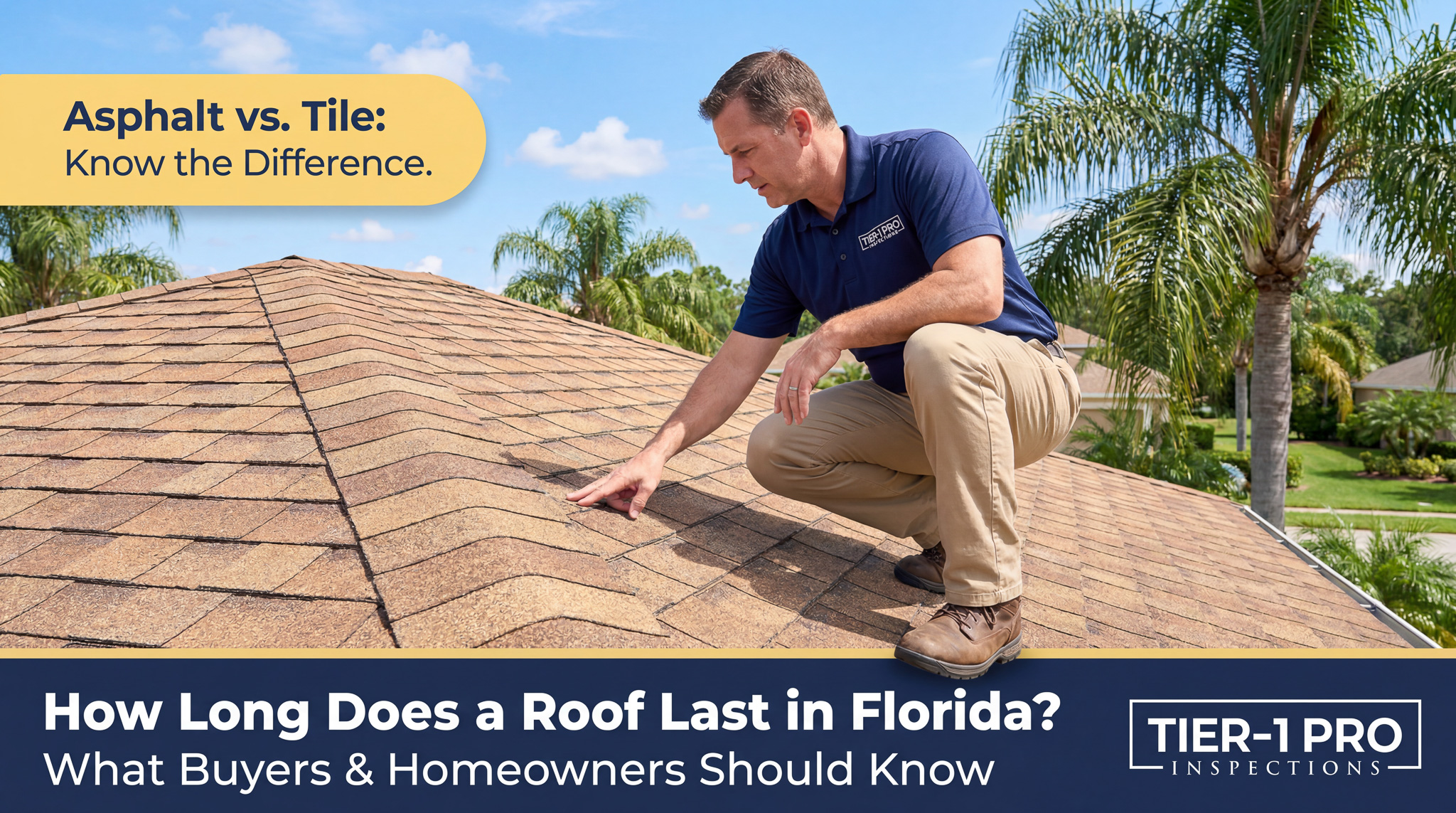
The answer most people expect when they ask how long a roof lasts is somewhere between 20 and 30 years, because that’s the figure cited on most asphalt shingle warranties and repeated broadly enough online that it has become the default assumption. In Florida, that number is wrong — or at least significantly optimistic — and the gap between the warranty expectation and the real-world lifespan in this climate has meaningful consequences for buyers evaluating a home, homeowners planning for replacement, and anyone dealing with a Florida insurance carrier who has opinions about roof age.
Florida is one of the most demanding environments for roofing materials on the planet. The combination of intense UV radiation, sustained heat that regularly pushes attic temperatures above 150 degrees in summer, a wet season that delivers months of daily rainfall and elevated humidity, hurricane-season wind exposure, and the biological reality of algae and lichen growth on roofing surfaces creates a degradation environment that compresses the functional lifespan of most materials compared to what those same materials would achieve in a northern or arid climate. When a manufacturer rates an asphalt shingle for 25 or 30 years, that rating is based on performance testing under standardized conditions that don’t reflect a Central Florida summer. Understanding what realistic lifespan looks like by material type — and understanding how Florida’s insurance market thinks about roof age — is some of the most practically useful information a homeowner or buyer in this region can have.
Roof Lifespan by Material in Florida’s Climate
Asphalt shingles are the most common roofing material in Central Florida’s residential housing stock, installed on the majority of homes built from the 1970s through the present. A three-tab asphalt shingle roof in Florida has a realistic functional lifespan of 15 to 20 years under normal conditions. Architectural or dimensional shingles, which are thicker and more wind-resistant than three-tab, extend that range to approximately 20 to 25 years in good conditions. Neither figure approaches the 25 to 30 year warranties printed on the packaging, because those warranties apply to the material’s resistance to manufacturing defects — not to UV degradation, thermal cycling, or the organic growth that accelerates surface granule loss in Florida’s humid conditions. A 20-year-old asphalt shingle roof in Central Florida is an old roof by the standards that matter most: what an insurance carrier will write a policy on and what a buyer’s four point inspection will document.
Concrete and clay tile roofing is far more durable in Florida’s climate and has become increasingly common in the region’s new construction and higher price-bracket existing homes. Properly installed tile roofing has a functional lifespan of 25 to 50 years and often beyond, which is one of the reasons it has become a preferred material in a market where insurance carriers are scrutinizing roof age. The distinction that buyers and owners of tile roofs need to understand is that the tile itself is not the only component with a lifespan. The underlayment beneath the tile — the waterproof membrane that does the actual work of keeping water out of the structure — has a shorter lifespan than the tile on top of it, typically 20 to 30 years depending on the material used and how well it was installed. A tile roof with 30-year-old underlayment may look intact from the street while actively allowing water infiltration at the deck level. Replacing underlayment on an existing tile roof requires removing and reinstalling the tiles, which is a significant cost that many homeowners don’t anticipate when they buy a home with a tile roof and assume they won’t need to think about it for decades.
Metal roofing — standing seam panels and metal shingles — represents the premium tier for longevity in Florida and has grown significantly in both residential new construction and as a replacement option for homeowners who want to reduce long-term replacement frequency. In Florida’s climate, well-installed metal roofing can realistically last 40 to 70 years. It handles UV exposure, heat cycling, and wind significantly better than asphalt, generates insurance credits in many cases due to its wind resistance performance, and has no organic surface components to support algae and lichen growth. The upfront installation cost is substantially higher than asphalt, but when evaluated on a cost-per-year basis across its service life, metal roofing compares favorably for homeowners who plan to remain in a property for an extended period. For buyers evaluating a home with an existing metal roof, the age of the installation and the condition of the fasteners, seams, and flashing details are the key inspection points — the roofing material itself will likely outlast most other components of the home.
Flat and low-slope roofing systems — modified bitumen, TPO, and EPDM membranes — appear frequently on additions, covered lanais, flat-roof sections of contemporary homes, and commercial-style residential construction. These materials have a functional lifespan of 15 to 20 years in Florida’s conditions, with performance heavily influenced by the quality of the installation, the condition of seams and penetration flashings, and how well the drainage system keeps standing water from accelerating membrane degradation. Flat roof sections are among the most common sources of active or historic water intrusion findings in home inspections, not because the material is inherently problematic but because the consequences of any seam failure or drainage deficiency are more direct and faster-moving than on a pitched roof where water naturally drains away.
What Florida Insurance Carriers Think About Roof Age
No single factor in a Florida homeowners insurance underwriting decision gets more attention than the roof, and roof age is the first thing an underwriter looks at when evaluating a property. The practical threshold that most Florida carriers apply is straightforward: asphalt shingle roofs that are 15 to 20 years old are approaching or at the boundary of insurability, and roofs beyond that range are increasingly difficult to place with standard carriers. Some insurers will write coverage on older asphalt roofs with a four point inspection confirming acceptable condition, but with a wind and hail exclusion — meaning the most likely type of claim from a Florida storm event isn’t covered. Others will require a signed commitment to replace the roof within a defined period as a condition of binding the policy. Many will decline to write the policy at all if the roof is past a certain age regardless of condition.
This is not an abstract market phenomenon — it has direct consequences for buyers in Central Florida’s existing home market. A buyer who falls in love with a 1998 home that shows well, has a great floor plan, and sits in a desirable neighborhood may discover at the insurance stage that the 25-year-old asphalt shingle roof makes the home difficult or expensive to insure, which affects both the monthly carrying cost of ownership and the home’s future resale profile. Discovering this before submitting an offer, or at minimum before the inspection contingency expires, gives the buyer options: negotiate a roof replacement or replacement credit as a condition of closing, adjust the offer price to reflect the capital expenditure on the horizon, or decide the property isn’t the right fit given the full cost picture. Discovering it after closing leaves the buyer absorbing that decision without recourse.
The four point inspection is the mechanism by which an insurance carrier evaluates a roof’s condition and remaining useful life in the context of an underwriting decision. The inspector documents the roof material, the approximate age, the current visible condition, and any evidence of damage or deterioration, and that documentation is what the insurer uses to make its coverage determination. For any home with an aging roof — and in Central Florida’s existing housing stock, a significant number of homes have roofs that are 15 years old or older — the four point inspection outcome is a material factor in the economics of the transaction. Buyers who understand this going in are prepared for the conversation. Buyers who encounter it for the first time when their insurance agent calls to discuss coverage terms are not.
What a Home Inspector Documents About the Roof
A pre-purchase home inspection evaluates the roof from a different angle than a four point inspection does. Where a four point inspection produces a document for an insurance carrier focused on age, material type, and condition summary, a home inspection evaluates the roof as a system — the condition of the shingles or other surface material, the state of the flashing at every penetration and transition, the condition of the ridge cap, the soffit and fascia, the gutters and their attachment, and any visible evidence of prior repairs, improper installation details, or active moisture intrusion at the decking level. The inspector accesses the attic and examines the underside of the roof deck for staining, moisture damage, and structural concerns that aren’t visible from the exterior.
The findings that matter most from a home inspection standpoint are often not the ones that look dramatic from the curb. Missing or improperly installed flashing at chimney bases, skylights, pipe boots, and roof-to-wall transitions is consistently among the most common sources of water intrusion in Florida homes, and it’s not visible to a buyer walking the property. Granule loss on asphalt shingles — the fine aggregate coating that protects the fiberglass mat beneath from UV degradation — accelerates as a shingle ages, and heavy granule accumulation in gutters and at downspout outlets is a reliable indicator that a shingle roof is in its terminal phase even when the surface still looks reasonably intact from ground level. Improper attic ventilation, which creates the sustained heat buildup that shortens shingle life from below while the sun shortens it from above, is another finding that doesn’t announce itself visually but has a direct effect on how quickly an already-aging roof reaches the end of its serviceable life.
For buyers in Central Florida evaluating a home with a roof that’s approaching the 15-year mark on asphalt shingles, or past 25 years on tile with unknown underlayment history, or showing any of these inspection findings, the question isn’t whether the roof will eventually need attention — it will. The question is how to appropriately price that reality into the transaction and ensure that what you’re agreeing to own reflects what the property actually costs to maintain, insure, and eventually pass on to someone else.
People Also Ask
How long does an asphalt shingle roof last in Florida?
A standard three-tab asphalt shingle roof has a realistic lifespan of 15 to 20 years in Florida’s climate. Architectural or dimensional shingles extend that range to approximately 20 to 25 years under good conditions. Both figures are shorter than manufacturer warranty periods because those warranties cover manufacturing defects, not the accelerated degradation produced by Florida’s UV intensity, heat, humidity, and storm exposure.
How long does a tile roof last in Florida?
Concrete and clay tile roofing can last 25 to 50 years or more in Florida, making it significantly more durable than asphalt in this climate. The critical caveat is the underlayment beneath the tile, which has a shorter lifespan — typically 20 to 30 years — and must eventually be replaced even when the tile itself remains intact. Buyers of homes with older tile roofs should ask about underlayment age and condition.
At what age does a Florida insurance company require a new roof?
Most Florida carriers begin scrutinizing asphalt shingle roofs at 15 to 20 years of age, with many declining to write new policies or standard coverage on roofs beyond that range. Some will insure older roofs with conditions attached — wind and hail exclusions, required replacement commitments, or surcharges. Tile and metal roofs are generally treated more favorably due to their longer expected lifespans. A four point inspection documents the roof’s age and condition and is typically required for any home over 10 years old.
What are the signs that a roof needs to be replaced in Florida?
Key indicators include:
- Visible granule loss with accumulation in gutters
- Cracked or curling shingles
- Missing or deteriorated flashing at penetrations and transitions
- Dark staining or streaking from algae growth
- Attic-level evidence of moisture intrusion at the deck
- Roof age at or past the material’s functional lifespan threshold
Some of these are visible from the ground; others require a close-up inspection or attic access to evaluate properly.
How much does a roof replacement cost in Central Florida?
Roof replacement costs vary based on the size of the home, the pitch of the roof, the material chosen, and labor market conditions. In the current Central Florida market, asphalt shingle replacement on a standard single-family home typically runs between $12,000 and $22,000. Tile re-roofing runs higher, often in the $20,000 to $40,000 range depending on scope. Metal roofing carries a higher upfront cost that varies significantly by system type. These ranges shift with material costs and contractor availability, so current contractor estimates are the most reliable guide.
Does roof age affect a home inspection?
Yes, though a home inspection evaluates the roof differently than a four point inspection does. A home inspector documents the roof’s surface condition, flashing integrity, visible damage, attic moisture evidence, and installation details as part of a comprehensive property evaluation. A four point inspection specifically documents roof age, material, and condition for an insurance carrier’s underwriting purposes. Buyers purchasing older homes benefit from having both, since they address related but distinct aspects of the same question.