
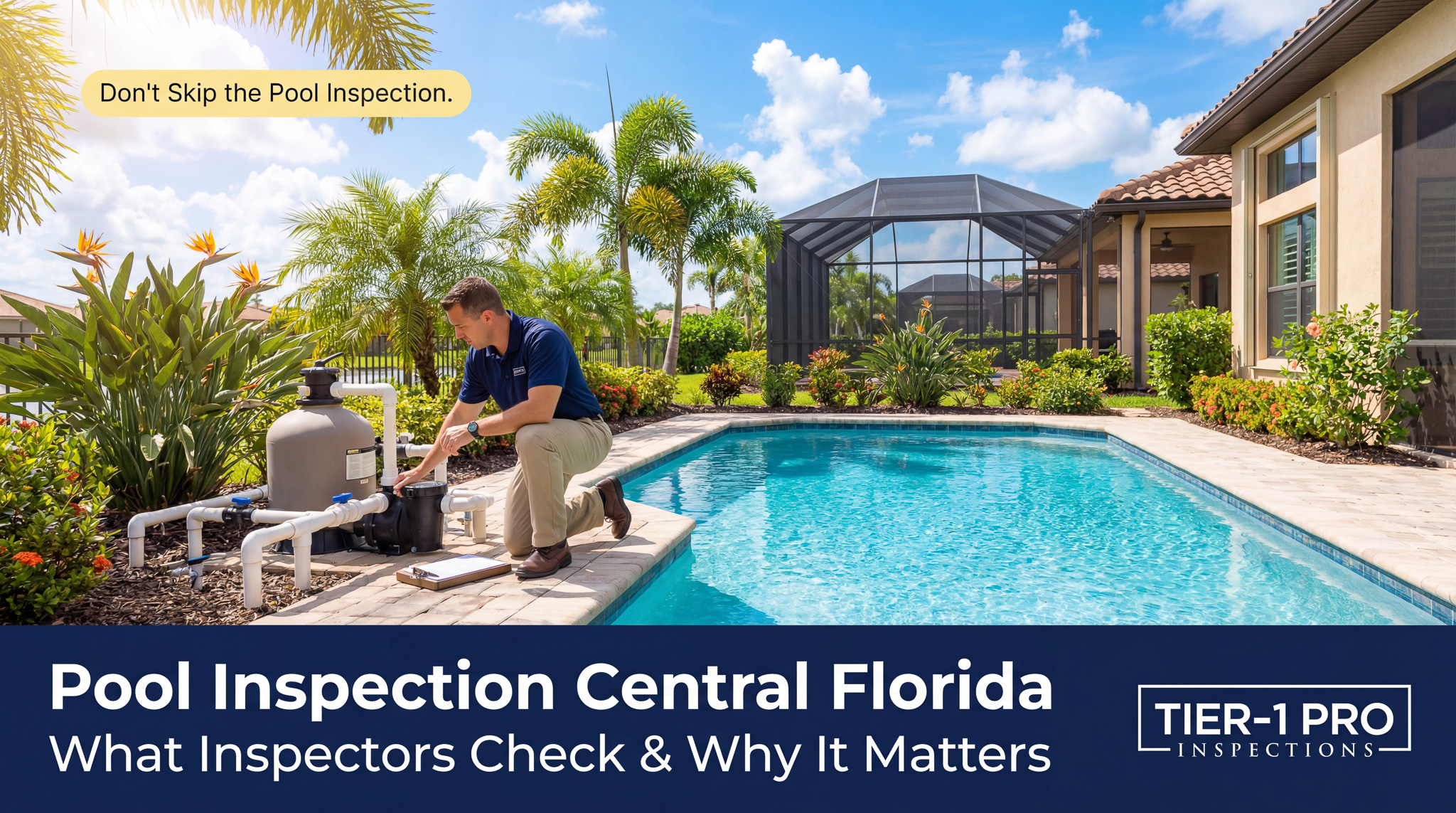
Florida has one of the highest rates of residential pool ownership in the country, and in Central Florida’s housing market — particularly in the mid-range and above price brackets across Orange, Osceola, Seminole, and Lake counties — a pool isn’t a luxury feature so much as a standard one. For buyers, that means the pool comes with the house whether you sought it out or not, and with it comes a mechanical system that has its own maintenance costs, its own failure modes, and its own safety obligations under Florida law. A pool that’s well-maintained and in good structural condition is an asset. A pool with deteriorating equipment, a slow plumbing leak, or a surface that needs resurfacing is a negotiating point — and potentially a significant one — if you know about it before you close.
The problem is that most buyers don’t know what they’re looking at when they walk around a pool deck. The water is clear, the pump is running, and the surface looks fine. That’s enough to feel comfortable, but it doesn’t tell you whether the pump is two years from failure, whether the pool is losing water at a rate that indicates a plumbing leak, whether the bonding system that protects swimmers from electrical shock is intact, or whether the barrier and drain covers meet the safety standards Florida law currently requires. A standard home inspection provides a general visual observation of the pool and its visible equipment, but it isn’t a dedicated pool evaluation. An advanced pool inspection is a separate, specialized service that covers the pool as a system — structure, equipment, plumbing, electrical, and safety — with the depth that a surface-level walk-around can’t provide.
What an Advanced Pool Inspection Covers
The structural evaluation begins with the pool shell — the gunite, plaster, pebble, or tile surface that lines the basin. Inspectors look for cracks, delamination, hollow spots, and surface deterioration that indicate the pool is due for resurfacing or, in more serious cases, that movement in the underlying substrate has created structural issues beyond what a cosmetic refinishing will resolve. Pool resurfacing in Central Florida typically runs between $5,000 and $15,000 or more depending on the size of the pool and the finish material chosen, which makes the condition of the existing surface a meaningful data point for buyers who are budgeting their first-year ownership costs.
Coping — the cap material along the pool edge — and the surrounding deck are evaluated for cracking, heaving, settlement, and trip hazards. Deck conditions are particularly relevant in Florida because the combination of heat, UV exposure, and the expansive clay soils common in parts of the region creates conditions where concrete decking can move and settle in ways that aren’t obvious until they’re inspected.
The equipment pad is where the mechanical complexity of a pool lives, and it’s one of the areas where buyers are most likely to be looking at a deferred expense they didn’t budget for. The inspector evaluates the pump, filter, heater or heat pump if present, salt chlorinator if the pool uses one, and any automation or control systems. Pool pumps typically have a functional lifespan of eight to twelve years under normal use, and in Central Florida’s heat and usage patterns, equipment at or past that range is worth noting.
Typical equipment replacement costs to budget for include:
- Variable-speed pump replacement: $500 to $1,500 installed
- Pool heater or heat pump: $2,000 to $4,000 or more
- Full automation system with aging control boards and actuators: considerably higher
None of these are emergencies in the way a roof or electrical panel can be, but they’re costs that land within a foreseeable timeframe and should factor into the picture a buyer is building about what the property will actually cost to own.
The electrical evaluation covers pool bonding and grounding, GFCI protection at the equipment pad and any exterior outlets serving the pool area, and the condition of underwater lighting fixtures and their junction boxes. Pool bonding is not optional or cosmetic — it’s a life-safety system. The bonding grid connects all metallic components of the pool (equipment, ladders, handrails, light niches, reinforcing steel in the shell) to equalize voltage and prevent the conditions that can cause electric shock drowning, a serious and underappreciated hazard in residential pools.
Older pools that haven’t had their bonding system inspected or updated may not meet current National Electrical Code standards, and that finding has implications both for safety and for insurance coverage. Underwater lighting is also evaluated because water intrusion into aging fixture niches creates both electrical hazard and a pathway for water loss that can be misidentified as a structural leak.
Safety features are evaluated against the requirements of Florida Statute Chapter 515, which establishes mandatory pool barrier standards for residential pools. The law requires a barrier — fence, wall, or screen enclosure — that limits a young child’s unsupervised access to the pool. Specific requirements govern:
- Fence height
- Gate hardware — self-closing, self-latching mechanisms that operate from the pool side
- Permissible gap dimensions at the base of a barrier
Inspectors also verify compliance with the Virginia Graeme Baker Pool and Spa Safety Act, the federal law that requires anti-entrapment drain covers on residential pools and spas. An improperly covered main drain creates an entrapment hazard, and non-compliant drain covers are a finding that needs to be addressed regardless of the age of the pool or the condition of everything else. For sellers, barrier and safety hardware deficiencies are straightforward and relatively inexpensive to correct before listing. For buyers who discover them post-closing, they become your responsibility to resolve — and your liability if they’re not addressed.
Pool Leak Detection: A Separate Service Worth Understanding
Pool leak detection is a distinct service from a pool inspection, and the two are frequently confused. A pool inspection evaluates the condition of the pool’s components and systems. Leak detection specifically determines whether the pool is losing water beyond normal evaporation, locates the source of the loss, and characterizes whether it’s a plumbing issue, a structural issue, or a fitting failure. They’re complementary services, and for buyers purchasing a home with a pool in Central Florida, having both done during the inspection period is the most complete picture available.
Every pool loses some water to evaporation — in Florida’s climate, that can be a quarter inch to half an inch per day during hot, dry, and windy conditions. The field benchmark for distinguishing normal evaporation from an actual leak is the bucket test: a bucket of water is placed on a step in the pool, filled to match the pool water level, and left for 24 to 48 hours. If the pool loses more water than the bucket, the pool has a leak beyond evaporation. The bucket test establishes that a leak exists. Professional leak detection determines where it is.
Plumbing pressure testing is the primary diagnostic tool for pool leaks that aren’t visibly apparent at the surface. The supply and return lines are isolated and pressurized with air or water, and a pressure drop under load indicates a breach somewhere in the line. Dye testing at specific locations — return fittings, skimmer throats, light niches, main drain covers — helps pinpoint where water is escaping when the plumbing pressure test is inconclusive or when the suspected leak location is at a fitting rather than in the pipe itself. For leaks in underground plumbing runs, electronic detection equipment can trace the leak’s location without excavation, which is a significant advantage in a market where the alternative — digging up deck and plumbing to find a problem — is both disruptive and expensive.
Common leak locations in Central Florida pools include:
- The skimmer throat, where the plastic skimmer body meets the gunite shell
- Return fittings that have degraded over time
- Light niches where the conduit penetration isn’t properly sealed
- Hairline cracks in the shell at points of stress or movement
Many of these are repairable without major structural intervention, but the cost and approach vary enough that knowing what you’re dealing with before closing — rather than after — is the difference between a negotiation and a surprise.
Buyers who are under contract on a home with a pool and who waive the pool leak detection service on the basis that the pool “looks fine” are making a decision without information. Water loss in a pool doesn’t announce itself visibly until the loss rate is significant enough to require frequent topping off, and by that point the pool owner has often normalized the refill habit without connecting it to a leak. A professional leak detection service completed during the inspection period gives the buyer documentation, gives them leverage, and gives the seller a clear path to resolution before closing.
People Also Ask
What does a pool inspection include in Florida?
A pool inspection covers the pool shell and surface condition, coping and deck, all equipment at the equipment pad (pump, filter, heater, automation), electrical systems including bonding and GFCI protection, underwater lighting, visible plumbing, and safety features including barrier compliance and drain covers. It produces a written report documenting the condition of each component and any deficiencies found.
Is a pool inspection the same as pool leak detection?
No. A pool inspection evaluates the overall condition of the pool’s components and systems. Pool leak detection is a separate diagnostic service that determines whether the pool is losing water beyond normal evaporation and identifies the specific source of the loss using pressure testing, dye testing, and electronic detection tools. The two services are complementary, and scheduling both during a home purchase inspection period gives buyers the most complete picture of the pool’s condition.
How much does a pool inspection cost in Central Florida?
Pool inspection pricing varies by company and the scope of the evaluation, but most advanced pool inspections in the Central Florida market run between $100 and $200 as a standalone service, with lower add-on pricing when bundled with a full home inspection. Pool leak detection is priced separately. Your inspection company can provide specific pricing and bundling options when you schedule.
What are the most common pool inspection findings in Florida?
Common findings include:
- Aging or end-of-life pump and filter equipment
- Surface delamination or cracks that indicate the pool is due for resurfacing
- Bonding system deficiencies
- Non-compliant safety barriers or gate hardware
- Degraded drain covers that don’t meet current anti-entrapment standards
- Evidence of water loss that warrants dedicated leak detection
Does Florida law require a pool fence or barrier?
Yes. Florida Statute Chapter 515 requires residential pools to have a barrier that limits unsupervised access by young children. Requirements cover fence height, gate hardware specifications (self-closing and self-latching mechanisms on the pool side), and allowable gap dimensions at the base of the barrier. Non-compliant barriers are a reportable finding and a safety concern that should be addressed promptly regardless of when the pool was originally built.
When should I schedule a pool inspection — before or after making an offer?
A pool inspection is most useful when completed during the inspection contingency period after you’re under contract, giving you time to review findings and negotiate with the seller before closing. If you have significant concerns about a pool’s condition prior to making an offer — visible equipment deterioration, obvious surface damage, or a pool that appears to have been neglected — it’s reasonable to factor that into your offer price before you’re under contract as well.