
The single most common reason buyers skip a home inspection on a new build is the assumption that new means correct. The house was just built. It passed the county building inspections. The builder has a warranty. What exactly is a home inspector going to find that all of that didn’t already catch? The answer, consistently and sometimes expensively, is quite a lot — and understanding why requires understanding what a municipal building inspection actually is versus what an independent new construction home inspection provides.
A county or city building inspector’s job is code compliance. They visit the job site at specific phases, verify that the work meets the minimum requirements of the local building code, and sign off on each stage before the next one begins. They are not evaluating quality, workmanship, or long-term durability. They are checking boxes against a code standard, and they’re doing it across dozens of active job sites on a given day. They are not your advocate, and they are not looking at your home the way a buyer’s inspector looks at it.
A builder’s punch list — the internal checklist the construction team walks before handing over the keys — serves the builder’s interests, not yours. It’s a quality control mechanism designed to catch cosmetic and operational issues that would be obvious at closing, not a systematic evaluation of the home’s systems and structure.
An independent new construction home inspection is conducted by a licensed inspector who is working exclusively for you, with no relationship to the builder, the developer, or the real estate agent representing the new community. Their only job is to document what’s right and what isn’t — and in new construction across Central Florida’s active development corridor, that list of deficiencies is longer and more varied than most buyers expect going in.
What New Construction Inspections Commonly Find
Central Florida is one of the highest-volume new construction markets in the country. The Orlando metro, Kissimmee, Ocoee, Winter Garden, Sanford, and the communities stretching out through Lake, Osceola, and Volusia counties have seen sustained development pressure for years, which means builders are operating under tight labor timelines and crews are often working multiple phases of multiple communities simultaneously. That environment produces the conditions where mistakes happen and get covered up — not necessarily through negligence, but through the ordinary reality of high-volume production homebuilding.
The defects that show up most often in new construction inspections include:
- HVAC ductwork that is improperly connected, kinked, or delivering conditioned air into wall cavities rather than into the living space
- Insulation in attics and exterior walls that is installed incorrectly, compressed, or simply missing in sections
- Plumbing that drains improperly due to inadequate slope or incorrect trap configuration
- Electrical panels with wiring errors, open knockouts, or improperly torqued connections
- Windows and exterior doors with installation gaps that create air and moisture infiltration pathways
- Grading issues around the foundation perimeter that direct water toward the home rather than away from it
Any one of these items discovered after closing is your problem to solve, on your timeline, at your expense — even with a builder’s warranty in place, because warranty claims involve the builder’s determination of what is and isn’t covered, not yours.
Roof deficiencies are also more common in new construction than buyers tend to expect. Improper flashing at penetrations, poorly seated ridge cap, insufficient fastening at the eaves, and attic ventilation configurations that don’t meet code are all findings that appear on new construction inspection reports with regularity. These aren’t dramatic structural failures — they’re installation details that didn’t get the attention they needed during a fast-moving construction schedule, and left unaddressed they shorten the roof’s effective life and can create moisture intrusion pathways that don’t announce themselves until the damage behind the walls is already significant.
Phase Inspections and Pre-Drywall Inspections
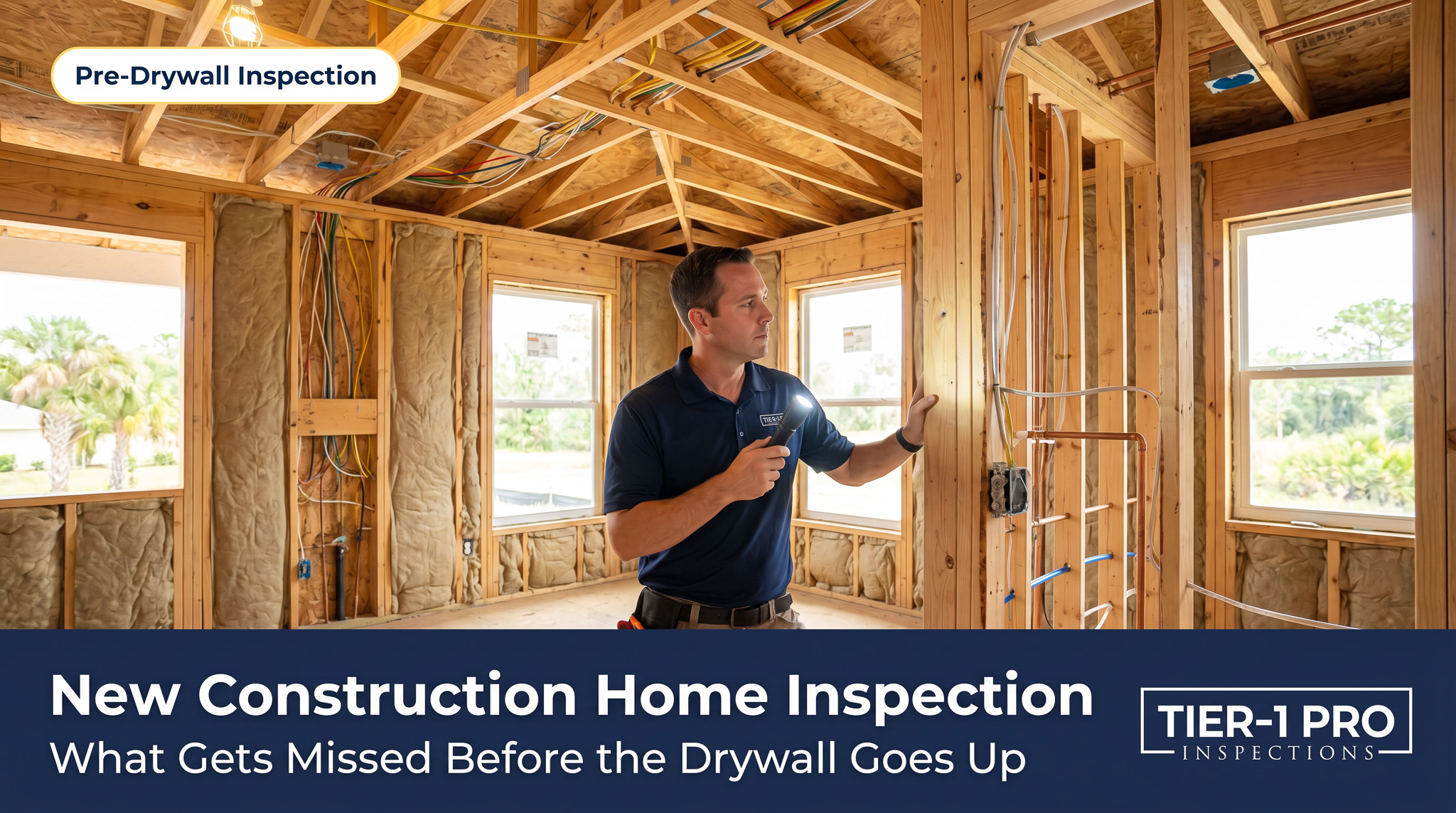
For buyers who are purchasing a home that hasn’t broken ground yet or is still mid-construction, a phase inspection strategy gives you access to parts of the home that will never be visible again once the walls are closed. The most valuable of these is the pre-drywall inspection, conducted after the framing, rough plumbing, rough electrical, and HVAC ductwork are in place but before the insulation and drywall go up.
At that stage, an inspector can see every structural connection, every pipe run, every wire path, and every duct joint in the home. Problems that are completely invisible after drywall — incorrectly run plumbing drain lines, HVAC duct connections that haven’t been sealed, missing fire blocking in wall cavities, structural framing that doesn’t match the engineered plan — are plainly visible and photographable at pre-drywall. Correcting any of these before the walls close costs a fraction of what it costs to diagnose and repair them after the home is finished.
Many builders will accommodate a pre-drywall inspection request with sufficient notice, particularly in communities where buyers are working with experienced real estate agents who have established that expectation. If your builder resists or discourages an independent inspection at any phase, that resistance itself is useful information. A builder who stands behind their work has no reason to limit your access to a licensed inspector at any point in the construction process.
A full phase inspection strategy for a home under construction typically includes:
- A pre-pour foundation inspection if the slab is being poured
- A pre-drywall framing and rough-in inspection
- A final inspection before closing
For buyers purchasing a spec home — one that’s already complete or nearly complete when they go under contract — the final pre-closing inspection is the only window they have, which makes it more important, not less.
The Builder Warranty Is Not a Substitute for an Inspection
Florida builder warranties typically follow a tiered structure:
- One year of coverage for workmanship and materials defects
- Two years for mechanical systems
- Ten years for structural defects
On paper, that sounds like a meaningful safety net. In practice, warranty claims are evaluated by the builder’s warranty department, using the builder’s definitions of what constitutes a covered defect, and resolved on the builder’s timeline. Disputes over whether something is a warranty defect or normal settling, a covered systems failure or improper homeowner maintenance, are common — and they’re disputes you’re navigating without leverage once you’ve already closed and moved in.
A pre-closing inspection, by contrast, gives you documented findings while the builder still has clear contractual motivation to address them. Builders want closings to happen on schedule, and a written inspection report from a licensed inspector identifying specific deficiencies gives you a formal, professional basis for requesting corrections before you take possession. That leverage disappears at closing. Attempting to exercise it afterward through a warranty claim process is slower, more adversarial, and less certain to produce the result you need.
The eleven-month home warranty inspection is a separate and equally important service for buyers who are approaching the end of their first year in a new construction home. Most builder warranties require defects to be reported within the coverage period to be eligible for repair. An inspection conducted around the ten or eleven month mark — before the one-year workmanship warranty expires — gives a licensed inspector the opportunity to identify and document issues that have developed or become visible since closing, while the builder is still contractually obligated to address them. This is a narrow window with real financial stakes, and the buyers who use it well are the ones who go into year two of homeownership without carrying the cost of issues their builder should have fixed.
People Also Ask
Do I really need a home inspection on a new construction home in Florida?
Yes. A municipal building inspection verifies code compliance at specific construction phases — it is not a comprehensive evaluation of quality, workmanship, or system performance. An independent new construction home inspection is conducted by a licensed inspector working exclusively for you, and it routinely identifies defects that building inspections and builder punch lists don’t catch. In Central Florida’s high-volume new construction market, these findings are common enough that skipping the inspection represents a meaningful financial risk.
What is a pre-drywall inspection and when should I schedule it?
A pre-drywall inspection is conducted after the framing, rough plumbing, rough electrical, and HVAC ductwork are installed but before insulation and drywall close the walls. It’s the only opportunity to visually verify the work inside your walls before it becomes permanently inaccessible. Problems found at this stage are far less expensive to correct than the same problems discovered after the home is finished. If your home is still under construction, coordinate with your builder to schedule this inspection as soon as framing and rough-in work are complete.
What kinds of defects do new construction inspections typically find?
Common findings include improperly connected or routed HVAC ductwork, missing or incorrectly installed insulation, plumbing drain slope and trap configuration issues, electrical wiring errors, window and door installation gaps, roof flashing deficiencies, and grading problems around the foundation. These are installation details that don’t reflect on the structural integrity of the home but can create significant maintenance and repair costs if not corrected before closing.
What is an eleven-month home warranty inspection?
An eleven-month warranty inspection is a pre-closing inspection conducted near the end of the builder’s one-year workmanship and materials warranty period. A licensed inspector evaluates the home for defects or deterioration that have developed since closing and documents findings while the builder is still contractually obligated to address them. It’s one of the most cost-effective inspections a new construction buyer can schedule and one of the most frequently overlooked.
Can a builder refuse to allow an independent home inspection during construction?
Builders generally cannot prohibit you from having an independent inspection, and most reputable builders will accommodate reasonable inspection requests with proper notice. If a builder actively discourages or resists independent inspections at any phase of construction, that posture is worth noting carefully. A builder who is confident in the quality of their work has no legitimate reason to limit your access to a licensed, independent inspector.
How is a new construction inspection different from a standard home inspection?
The scope is similar — both evaluate structure, roofing, electrical, plumbing, HVAC, and other systems — but the context is different. A new construction inspection focuses on installation quality, construction defects, and code compliance issues specific to new builds. It also opens the door to phase inspections like pre-drywall evaluations that don’t apply to existing homes. For homes still under construction, the pre-drywall phase inspection is a capability that makes new construction inspections uniquely valuable compared to inspections of completed existing homes.