
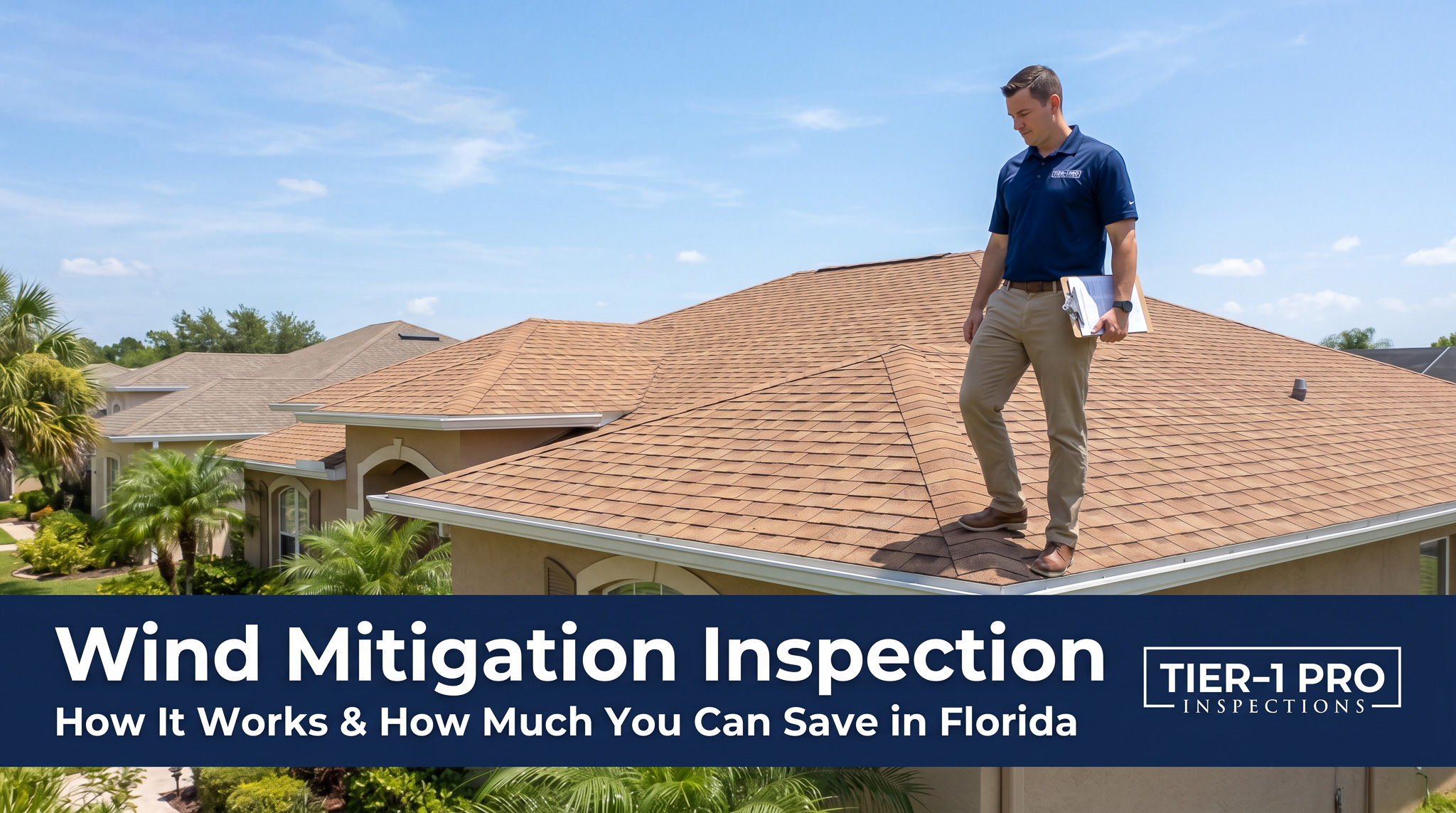
A wind mitigation inspection is one of the few things a Florida homeowner can do that produces a direct, documented, and often substantial reduction in what they pay for homeowners insurance. Depending on how your home is built, a single inspection — typically completed in under an hour — can reduce your annual premium by hundreds of dollars. Florida law requires insurance carriers to offer discounts for verified wind mitigation features, which means the savings aren’t discretionary on the carrier’s part. If the qualifying features are present and properly documented, the discounts must be applied. That makes the wind mitigation inspection one of the highest-return services a Central Florida homeowner can schedule, often recovering its entire cost within the first renewal cycle.
The inspection itself is a structured evaluation of six specific categories defined by the Florida Office of Insurance Regulation’s standard wind mitigation form. A licensed inspector works through each one, photographs the qualifying features, and produces a completed report that goes to your insurance agent or carrier. What those six categories are — and why each one matters — is worth understanding before you schedule, because it helps you know what to expect from the report and how your home’s specific construction will affect your credits.
What the Inspection Actually Evaluates
Roof shape is the first category, and it carries more weight than most homeowners expect. A hip roof — the style where all four sides slope down to the walls — performs significantly better under wind load than a gable roof, which has two flat triangular end walls that behave more like sails under lateral pressure. Florida insurers know this from decades of post-storm damage data, and the discount for a qualifying hip or predominantly hip roof reflects it. Many Central Florida homes built since the late 1980s and 1990s have hip or partial hip configurations, and homeowners with these roof shapes are leaving money on the table if they don’t have a current wind mitigation report on file with their carrier. This credit alone — before any other feature is evaluated — can meaningfully reduce the wind portion of a premium.
Roof covering and roof deck attachment are the next two categories, and together they speak to how well the roof assembly holds up as a system under storm conditions. The covering category documents the material type and when it was installed, with roofing systems installed after Florida’s major code updates in 2002 and 2007 generally qualifying for better credits because they were applied to more rigorous wind-resistance standards. Deck attachment evaluates how the plywood or OSB sheathing is fastened to the framing beneath it — specifically the nail length and spacing used to secure the deck to the trusses or rafters. An inspector verifies this by accessing the attic and physically examining the fastener pattern where the deck meets the structural framing. This detail matters because deck uplift is one of the primary failure modes during high-wind events. A deck fastened with longer nails at tighter spacing resists uplift forces that would peel back a less robustly fastened deck, and the credits reflect that difference in performance.
Roof-to-wall connections are the hardware that ties the roof structure to the walls of the home — the single most structurally critical link in the wind-resistance chain, and the point where storm failures tend to be the most catastrophic and expensive. The weakest connection type is a toe-nail, which is a nail driven at an angle through the base of a truss into the top plate of the wall. It holds under normal conditions but has limited resistance to the uplift forces a major storm generates. More favorable connections use metal clips or straps that wrap over and around the truss, mechanically anchoring the roof structure to the wall framing. The strongest are double-wraps and structural anchors. Florida’s updated building code, which took effect in 2002, required enhanced connectors in new construction across the state. That means homes built in the Orlando metro, Kissimmee, Ocoee, and surrounding Central Florida communities after that period often carry this credit. Older homes are more varied depending on when and how they were built, and the inspector’s attic evaluation is the only way to know which connection type is actually present.
Opening protection covers how your windows, doors, skylights, and garage doors are protected against wind-borne debris and pressure differential — two of the primary mechanisms through which wind causes interior structural damage during a storm. Homes with impact-resistant windows and doors throughout, or with hurricane-rated shutters or panels for every opening, receive the most favorable treatment in this category. Partial protection yields partial credit. No protection yields no credit in this category, though there’s no penalty — the home simply doesn’t qualify for that particular discount. For homeowners who are weighing whether to invest in impact windows or shutters, understanding how the opening protection credit interacts with their overall wind mitigation profile can help frame the return on that investment.
Secondary water resistance is the final category. It refers to a sealed underlayment layer — typically a peel-and-stick rubberized membrane applied directly to the roof deck before the primary roofing material goes on — that prevents water from entering the structure if the outer roofing layer is damaged or removed during a storm. It’s the backup waterproofing layer that keeps a roof watertight even if tiles blow off or shingles are stripped. Homes built or re-roofed to current Florida Building Code typically have this feature, and inspectors verify it either by examining the underlayment visible in the attic or through documentation from the roofing contractor who completed the work.
How the Savings Work and What to Expect
Florida Statute 627.0629 requires insurance carriers to provide actuarially justified discounts for each verified wind mitigation feature. The credits stack — meaning a home that qualifies in multiple categories receives the combined benefit of all of them. The maximum total discount can reach 88% of the wind portion of the homeowners insurance premium. That’s not 88% of the entire bill, but the wind component is a substantial part of what Florida homeowners pay, and the math adds up quickly. A homeowner whose wind premium component runs $1,500 annually and whose home qualifies across several categories could realistically see their net cost drop by $800 to $1,200 or more per year. Even homes that qualify only for a hip roof credit and an enhanced deck attachment credit often see $200 to $500 in annual savings — enough to recover the cost of the inspection many times over across a five-year report period.
The report Tier-1 Pro Inspections produces uses the standard OIR-B1-1802 form accepted by all Florida carriers. It includes photographs of each qualifying feature and documents findings with enough specificity for an underwriter to apply the correct credits. You submit the completed report to your insurance agent, and the discounts are applied at your next renewal or when you bind a new policy. The report is valid for five years, though many carriers will continue to honor it beyond that period if the roof hasn’t been replaced or significantly modified. After any re-roofing, scheduling a new inspection promptly is worth doing — updated materials and installation practices often qualify for better credits than what the older report reflected, and the sooner the new report is submitted, the sooner the improved credits take effect.
The most efficient time to schedule a wind mitigation inspection is when you’re purchasing a home or approaching a policy renewal. For buyers in Central Florida, bundling the wind mitigation inspection with a pre-purchase home inspection and a four point inspection means all three are completed during a single visit, with bundled pricing that reduces the total cost compared to scheduling each separately. You’ll have everything your insurance agent needs to bind the policy with the correct discounts applied from day one rather than waiting for a renewal cycle to capture them. For existing homeowners who have never had an inspection done — or whose report is aging toward the five-year mark — there’s no reason to wait for a trigger event. If your home has qualifying features, your current premium may already be higher than it needs to be, and an updated report can prompt a mid-term rate review with your carrier at any time.
People Also Ask
What is a wind mitigation inspection?
A wind mitigation inspection is a licensed evaluation of the structural and material features that determine how well a home can resist wind damage. An inspector assesses six categories — roof shape, roof covering, roof deck attachment, roof-to-wall connections, opening protection, and secondary water resistance — and produces a standardized report used by your insurer to calculate premium discounts. Florida law requires carriers to offer these discounts for verified qualifying features.
How much can a wind mitigation inspection save me on my Florida homeowners insurance?
The maximum combined discount is 88% of the wind portion of your premium. Actual savings depend on which features your home has and how your carrier weights each credit. Most Central Florida homeowners who qualify across several categories see annual savings between $200 and $600 or more, making the inspection cost — typically $75 to $150 — recover itself within the first policy year.
How long does a wind mitigation inspection take?
Most single-family homes take between 45 minutes and an hour. The inspector examines the exterior, accesses the attic to evaluate deck attachment and roof-to-wall connections, and documents all six categories with photographs. Reports are typically delivered the same day.
How long is a wind mitigation report valid in Florida?
Five years from the date of inspection. Many carriers will continue to accept an older report if no significant changes have been made to the covered systems, particularly the roof. After any re-roofing, a new inspection is recommended because updated installation practices often yield better credits than the prior report reflected.
Does every Florida home qualify for wind mitigation discounts?
Not every home qualifies for every category, but most qualify for something. Roof shape alone — if the home has a hip or partial hip configuration — generates a credit regardless of the home’s age or other features. Homes built after 2002 tend to qualify across more categories because the updated Florida Building Code required more robust construction standards. Even older homes often qualify for partial credits depending on original construction and any improvements made since.
Can I get a wind mitigation inspection when buying a home, not one I already own?
Yes, and it’s the ideal time to schedule one. Completing the wind mitigation inspection alongside your pre-purchase and four point inspections means all three are done in a single visit. You’ll have the report ready to submit when you bind your homeowners insurance policy, capturing the discounts from your very first premium rather than waiting for a future renewal.